MEV spacecraft detaches from Optus satellite after a year in orbit

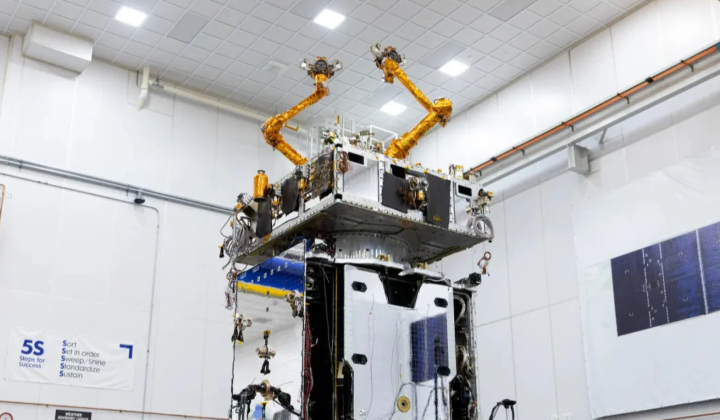
MEV spacecraft from Northrop Grumman
According to НВ — Техно: Publication date: August 13, 12:15
The MEV spacecraft from Northrop Grumman has detached from the Australian communications satellite Optus after over a year of maintaining it in the required orbit. The MEV successfully ensured the satellite's position stability, allowing its continued operation. In July of this year, SpaceX's Falcon 9 rocket launched four Northrop Grumman spacecraft into orbit, including the main Mission Robotic Vehicle (MRV) with two DARPA-developed manipulators and three Mission Extension Pods (MEP).
Prospects for satellite servicing
The quartet of spacecraft is heading to targets at an altitude of about 43,500 kilometers above Earth. In 2027, the MRV is expected to attach one of the MEP modules to the Optus satellite, which will allow its operation to continue for another six years, which is important for the satellite operator. Optus was launched in 2009 with a planned service life of 15 years, and the servicing provided by Northrop Grumman's spacecraft can extend this term and improve the company's profits.
It is worth noting that the two MEV spacecraft, launched in 2019 and 2020, have already added ten years of operation for three customers, including two Intelsat satellites and Optus. Operators purchase MEP modules for ownership, and the MRV is freed up to service other satellites. It is also important that the MRV can be refueled in orbit, opening new possibilities for servicing spacecraft.
Among the potential clients of Northrop Grumman's APARATs are military entities that use expensive satellites in high orbits. The U.S. Space Force had previously pointed to a Chinese servicing spacecraft with manipulators as a weapon, however, Northrop Grumman emphasizes the purely service-oriented purpose of its technology.
Cassie Wong stated, 'This is a paradigm shift where we will be able to see space as sustainable, with a more resilient architecture and infrastructure base where spacecraft can be repaired, their resources extended, or even upgraded and serviced.'
Servicing satellites using new technologies such as MEV and MRV opens up new opportunities to extend the lifespan of spacecraft, which in turn can reduce costs for satellite operators. It also highlights the importance of innovation in the field of space technologies that can change the game in communications and military applications. With the development of such technologies, the space infrastructure becomes more stable and ready for new challenges, which may positively impact the global space economy.
As Northrop Grumman continues to advance its satellite servicing capabilities, the upcoming plans for lunar exploration are also gaining momentum. NASA aims to achieve over 20 lunar landings by 2029, which is part of a broader strategy to establish a sustainable presence on the Moon. This ambitious initiative highlights the growing importance of space infrastructure and the potential for collaboration between private and governmental entities in the realm of space exploration. For more details on NASA's lunar ambitions, read about their plans to establish a Moon base by 2029.

Read also