Astronomers Discover a Colossal Cosmic Laser 8 Billion Light-Years Away

A Breakthrough in Astronomy
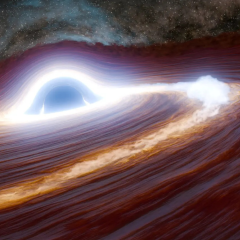
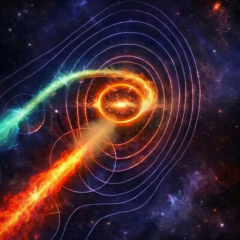
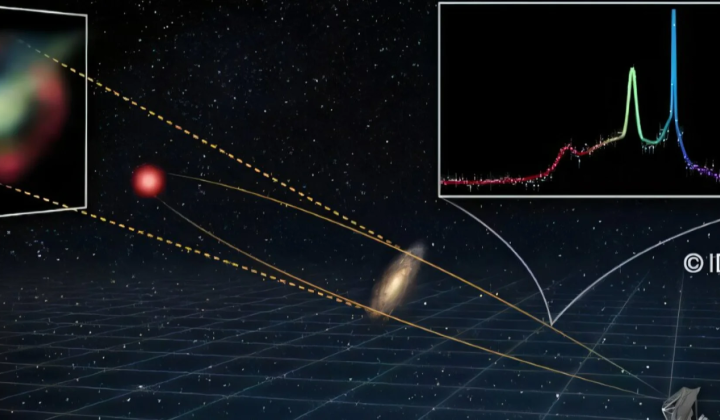
According to НВ — Техно: On June 14 at 5:07 PM, astronomers announced a major discovery: the detection of a hydroxyl megamaser-a natural cosmic laser-located in a merging galaxy more than 8 billion light-years from Earth. This finding was made possible through observations with the MeerKAT radio telescope, where the signal was amplified by gravitational lensing. The entire observation took just 5 hours.
The hydroxyl megamaser resides within a violently merging galaxy. At the time of detection, the universe was approximately 13.8 billion years old. Scientists managed to capture both the hydroxyl line and neutral hydrogen absorption in a single observation. The researchers behind this project are Tato Manamela, a postdoctoral fellow at the University of Pretoria, and Roger Dean, director of the Inter-University Institute for Astronomy.
We are not seeing the galaxy as it is today. We are seeing it as it was 8 billion years ago. Since the Big Bang, which occurred about 13.8 billion years ago, we are observing a 'younger' version of the universe. At the stage when the maser signal was emitted by the host galaxy, galaxies were much more 'chaotic'-they collided more often and were far more active than the stable, mature galaxies we see nearby today.
Tato Manamela
Speed and Uniqueness of the Discovery
Highlighting the speed of the discovery, Manamela added: 'In just five hours of observations, we detected a signal that would normally require hundreds of hours, given its distance and rarity. But gravitational lensing amplified the signal enough for us to detect it. Additionally, although we were targeting neutral hydrogen, MeerKAT's wide bandwidth allowed us to unexpectedly pick up the megamaser signal in the same data.'
The researchers also emphasized the uniqueness of the situation: 'It is rare for a single astrophysical system-a collection of celestial objects, in this case two galaxies forming a lensing system-to change our understanding of the universe. Usually, we need large samples for that. But the combination of a record-breaking distance and the speed of the discovery was remarkable.'
This discovery opens new frontiers for studying the distant cosmos and could lead to further findings in future research with the MeerKAT telescope and the SKA observatory. Studying the hydroxyl megamaser not only expands our knowledge of the early stages of the universe but also demonstrates the potential of new technologies and observation methods that could transform our understanding of cosmic processes and galaxy structure.
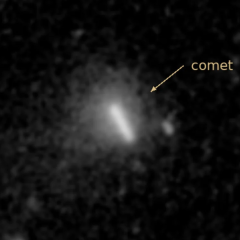
As astronomers continue to unveil the mysteries of our universe, recent findings about the unusual composition of interstellar comets highlight the diverse chemical environments present even in distant cosmic bodies. This discovery not only complements the recent detection of the colossal cosmic laser but also emphasizes how much there is yet to learn about the early universe and its formation processes.

Read also