Membership of a Different Kind? Why Ukraine's Path to the EU Has Proven More Complicated than Orban's Veto
European 'Lobby'
Brussels is seeking a way to accelerate EU enlargement without importing the right to block decisions, agricultural conflicts, and new budget commitments along with new members. For Ukraine, this creates an unpleasant dilemma: rapid integration could prove incomplete, while full membership may be significantly slower.
The European Commission is preparing a new model for enlargement that should allow Ukraine, Moldova, and the Western Balkan countries to integrate into the EU more quickly than the classic procedure provides. According to El País and Reuters, candidates may be granted earlier access to parts of the single market, energy, transport, and defense policy, but special safeguards may be simultaneously introduced: temporary restrictions on the use of the veto, the possibility of suspending specific rights in case of deviation from EU rules, as well as transitional regimes for agriculture and worker mobility.
To call this an already approved 'second-class membership' would be premature. It concerns a project for a new architecture of enlargement that still needs to be approved by the member states. However, the political problem is articulated quite openly: the EU wants to expand while not wishing to acquire a Union with more than 30 states, where even more decisions can be blocked by a single vote. Hungary's experience has become one of the arguments in favor of new safeguards.
This discussion did not start yesterday. Back in spring, German Chancellor Friedrich Merz proposed an interim status of associated membership for Ukraine: participation in the work of EU institutions, access to part of programs and specific EU mechanisms, but without full voting rights. Volodymyr Zelensky rejected this model, insisting that the ultimate goal must remain full membership with equal rights.
Orban Is Gone. The Problems Remain
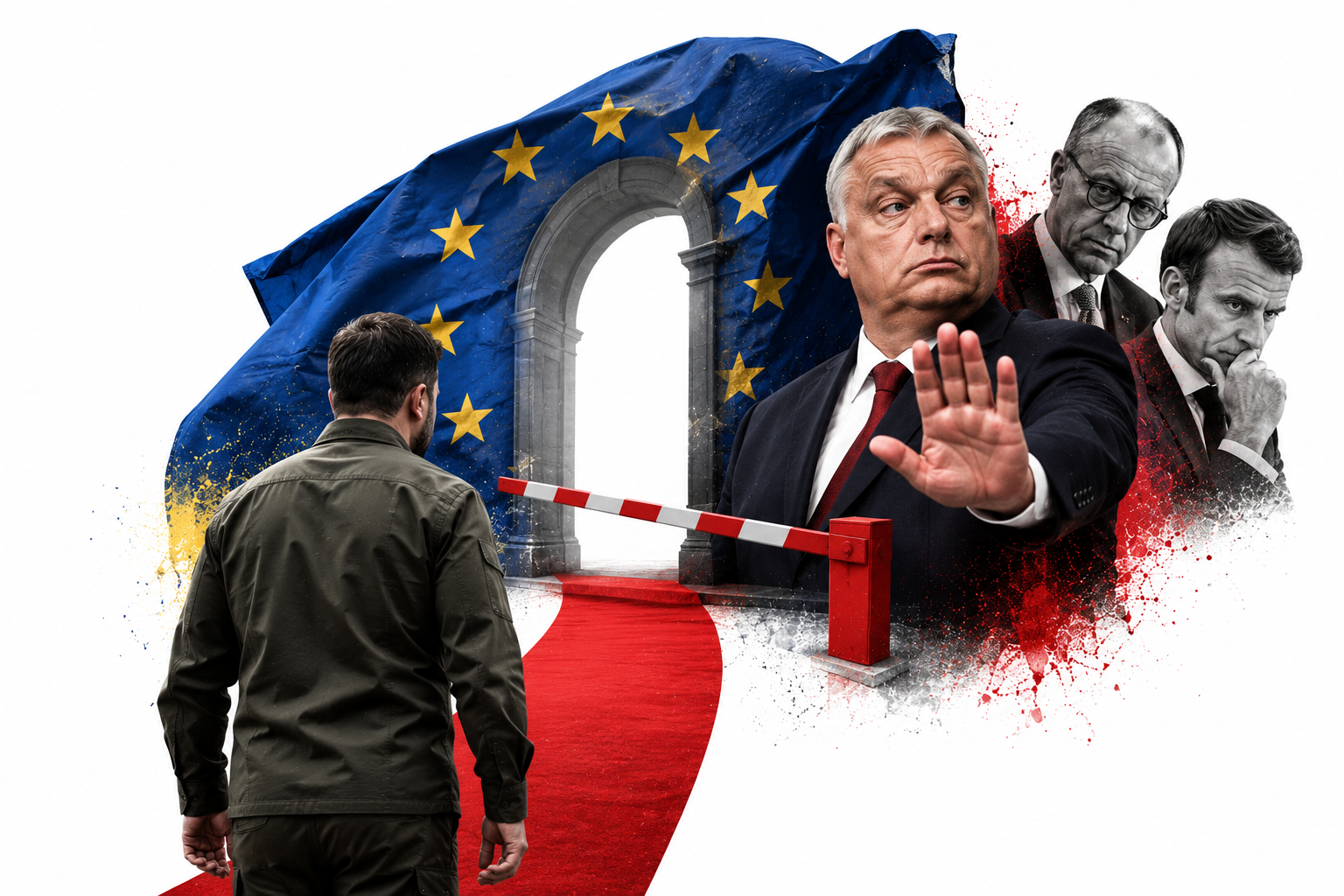
The change of power in Hungary brought an interesting political experiment. Under Viktor Orban, Budapest was indeed the main brake on the Ukrainian negotiation process. After the arrival of Peter Mader, the situation changed noticeably: Hungary allowed the first negotiation cluster to be opened, and in June 2026 it was officially opened.
However, Orban's disappearance did not mean the automatic vanishing of Hungarian objections. Mader opposed the too-rapid advancement of Ukraine, demanded guarantees for the rights of the Hungarian minority in Transcarpathia, and stated that Ukraine's final membership must be decided in Hungary through a legally binding referendum. In September, Budapest again delayed the opening of the next negotiation blocks. At the same time, to call this evidence that Mader simply continued Orban's policy would also be inaccurate: on October 2, Reuters reported progress in negotiations regarding minority rights, after which Hungary might lift objections regarding two more clusters.
Thus, the myth is not that Orban blocked Ukraine - he really did. The illusion was different: the assumption that after removing one Hungarian veto, the whole path to membership would become a mere technical formality. Hungary was a political obstacle. But behind it lay much more complex budgetary, agricultural, and institutional issues that do not disappear with a change of prime minister in Budapest.
The Most Expensive Question - Not the Flag, but the Budget
Ukraine fundamentally differs from most previous candidates. It is a large state with a vast agricultural sector, significant recovery needs, and an army, the scale of which after years of war has no analog among current EU members. Its full entry means not just adding another flag in front of the European Commission building but a potential redistribution of money and political weight within the Union.
Agriculture is particularly sensitive. Estimates of the cost of integrating Ukraine into the Common Agricultural Policy vary, so using the popular figure of €186 billion just for Ukrainian farmers is inaccurate. The European Parliament cites significantly lower estimates: about €85-96.5 billion in agricultural payments over a seven-year budget cycle, depending on the methodology. It is precisely the scale of Ukrainian agricultural lands that explains why Brussels is already discussing limited access for Ukraine to agricultural subsidies and special transitional mechanisms.
This is the true political economy of enlargement. For a French or Polish farmer, Ukrainian membership is a matter of competition and the future of the CAP. For donor countries, it is a matter of the size of the European budget. For Brussels, it is a matter of managing the Union. For Kyiv, it is the question of whether the word 'membership' will mean the same rights currently enjoyed by Warsaw, Paris, or Budapest.
That is why it would be an exaggeration to say that a 'financial-agricultural consensus of the whole EU against Ukraine' is already formed. No such consensus exists: the European Commission officially promotes Ukrainian membership, and the negotiation process is already underway. However, a different consensus is becoming increasingly clear - Ukraine is wanted to be integrated in such a way that its entry does not cause a budgetary, agricultural, or institutional shock for the Union itself.
The Price of Full Membership
Therefore, the dispute between Kyiv and the advocates of phased integration is not really about a single word. For Ukraine, an interim status contains an obvious risk: a temporary 'lobby' may turn out to be very protracted. This argument resonates within the EU itself - particularly Ireland has warned that associated membership could leave Ukraine in a semi-integrated state and weaken the incentives to move towards full membership.
But the position of 'only full membership and as soon as possible' also faces political arithmetic. Admission requires the completion of negotiations, meeting of criteria, and ratification of the accession agreement by all member states in accordance with their constitutional procedures. To assert that the parliaments of Austria, the Netherlands, Slovakia, or Hungary will certainly vote against is impossible - this will depend on the conditions of the agreement and the political situation at the time of ratification. However, every additional guarantee for the Ukrainian agricultural sector, every billion in future transfers, and every right to block decisions of the Union will complicate negotiations.
And herein lies the paradox. Geopolitics is pushing Europe towards Ukraine faster than ever. Political economy forces it to press the brakes. Brussels is trying to find a construction in which Ukraine finds itself within the European system without immediately receiving all the levers and financial rights of old members.
For Kyiv, the choice is therefore more complicated than 'full or second-class membership'. The question is different: will it agree to phased integration as a bridge to full membership - and how to ensure that this bridge does not one day turn into a permanent address.

Read also