Stellar Winds Caused Early Galaxies to Die Young

Insights from the CRISTAL-02 Galaxy Study
According to НВ — Техно: Fresh observations reveal that ancient galaxies, including the system known as CRISTAL-02, underwent rapid evolution and met an early demise due to powerful stellar winds triggered by collisions. This research found that CRISTAL-02, which existed roughly 1 billion years after the Big Bang, expels gas twice as fast as it creates new stars. Such a rate could halt star formation in less than 100 million years.
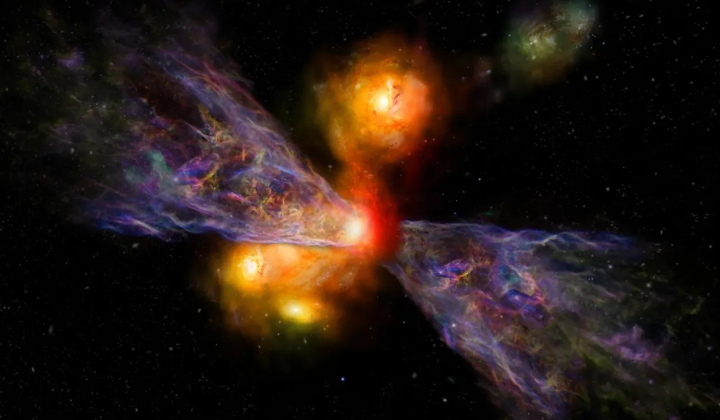
With a mass approximately 10 billion times that of the Sun, CRISTAL-02 formed from the merger of multiple objects. Scientists have detected a gas tail nearly as long as the galaxy itself, containing material equivalent to 1.5 billion solar masses. This gas stream travels at hundreds of kilometers per second. The outflow is driven by winds from rapid star birth and the widespread deaths of massive stars, which explode as supernovae after just a few million years.
Galactic Evolution and Interactions
Each year, CRISTAL-02 produces about 260 new stars but loses over 500 solar masses of material. This means the galaxy is ejecting gas at double the rate it forms stars, potentially exhausting its supply of building material in under 100 million years.
Interestingly, in the broader context of galactic evolution, the Milky Way is set to collide with the Andromeda Galaxy in roughly 4.5 billion years, eventually merging into a single large elliptical galaxy.
An illustration of the CRISTAL-02 galaxy, showing the outflow of gas, was created by Joshua Worth under a Creative Commons license.
The study, published in the Monthly Notices of the Royal Astronomical Society on June 23 at 6:30 PM, opens new avenues for understanding the processes at work in early galaxies.
Examining CRISTAL-02 highlights the importance of studying galactic evolution in the early universe, as the speed of gas expulsion can dramatically affect new star formation. This discovery also offers fresh insights into how galaxies merge and evolve, and what factors determine their life cycles. Such research is key to understanding not just individual galaxies, but the broader processes of structure formation across the cosmos.
Understanding the dynamics of early galaxies is crucial, especially when considering the findings of the Webb Telescope's observations of winds affecting galaxies. These insights complement the CRISTAL-02 study by illustrating how powerful stellar winds can significantly influence galaxy evolution and star formation rates across the universe.

Read also