Ringelmann Effect – What It Is and How It Affects Team Productivity


The Ringelmann effect has been one of the key concepts in labor psychology and group dynamics for many years. It describes an interesting yet paradoxical phenomenon: as a group gets larger, the less productive each individual's contribution can become.
This tool is often used in business and workplace organization. The effect is especially noticeable in situations where a task requires collective efforts and does not allow for clear measurement of who is contributing how much to the common goal. In modern conditions, where most companies operate in a team format, understanding this phenomenon helps managers, HR specialists, and employees themselves better organize interactions, avoid hidden productivity decline, and build effective workflows.
The Ringelmann effect not only describes the peculiarities of human behavior in a group but also helps to see the real reasons why sometimes the strongest teams do not achieve the desired results.
What is the Ringelmann Effect?
The Ringelmann effect is a psychological phenomenon in which an individual's productivity decreases as the size of the group increases. Simply put, a person works less intensively when performing a task in a group than when doing it alone. However, the overall team result still increases, but not proportionally to the number of participants. The reduction in individual contributions is usually associated with the fact that responsibility is shared among all, and each participant begins to unconsciously exert less effort.
In practical understanding, the Ringelmann effect manifests itself not only in physical work but also in intellectual, creative, organizational, and other types of activities. In teams where there is no clear structure, defined roles, or control systems, it manifests especially strongly. That is why this effect is considered an important part of analyzing team effectiveness and group behavior.
The History of the Discovery and Study of the Ringelmann Effect
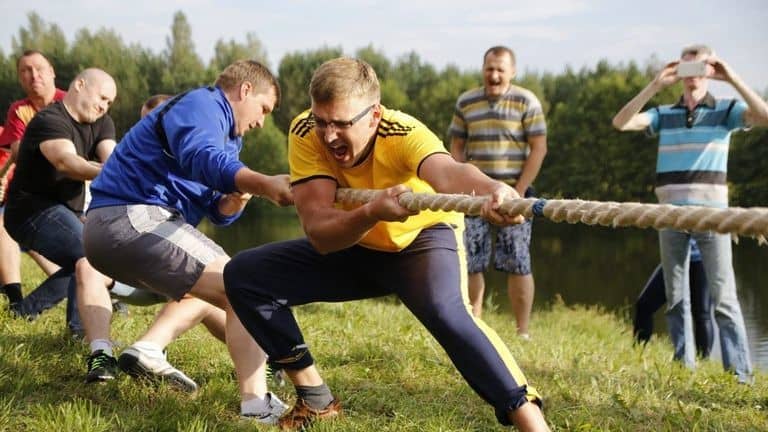
The phenomenon was discovered in the late 19th century by French engineer and agronomist Maximilien Ringelmann. He studied labor productivity in agriculture and became interested in how the intensity of physical effort changes when people work together. During his experiments, he asked participants to pull a rope both alone and in groups of different sizes.
The results were unexpected: when a person pulled the rope alone, he exerted maximum effort. But as soon as others joined him, the individual contribution began to decrease. For example, if two people could theoretically pull twice as hard as one participant, in practice each of them showed about 90% of their effort. In a group of three, it was only 85%, and in a group of eight, about 45%.
This effect turned out to be so persistent that it was later confirmed by numerous social-psychological studies in the 20th and 21st centuries. In modern understanding, it has become the basis for deeper analysis of group behavior, particularly the concepts of social loafing, diffusion of responsibility, and decreased motivation in teamwork.
The Mechanism of the Ringelmann Effect Manifestation
The mechanism of the Ringelmann effect is based on the psychological distribution of responsibility and the decrease in intrinsic motivation. When a person works alone, he clearly realizes that the result depends solely on him. In a team, however, responsibility is diluted, and participants begin to unconsciously assume that others will also exert their efforts, allowing them to work a little less intensively.

Another element of the mechanism is the difficulty of assessing individual contributions. If the task is team-based and there is no way to determine who is performing what part of the work, a feeling of "anonymity of actions" arises. A person stops feeling necessary and noticeable, and therefore motivation weakens.
Cognitive load also plays an important role. In larger groups, coordination becomes more complicated, additional communication barriers arise, and decision-making speed decreases. This also partially contributes to participants sometimes retreating into a more passive position. Thus, the Ringelmann effect consists of a combination of psychological and social processes that subtly influence people’s behavior in a group.
Reasons for the Decrease in Individual Productivity in Groups
The reasons for the manifestation of the Ringelmann effect have several levels. What is being talked about:
- Diffusion of responsibility. When a task is undertaken not by one person but by a group, the feeling of personal responsibility decreases. A participant begins to think that others will compensate for their efforts.
- Social loafing. People tend to put in less effort if they are sure that their contribution cannot be clearly assessed. The absence of individual visibility reduces motivation.
- Loss of coordination. In larger groups, it is harder to align actions. Even if everyone strives to work efficiently, part of the productivity is lost due to chaos, improper task distribution, and duplication of work.
- Decreased intrinsic motivation. When a person does not see himself as a key element of the process, his involvement drops. In a collective, it is easier to "get lost," which affects labor intensity.
- Lack of individual feedback. If team results are evaluated without considering personal contributions, people stop feeling that their work matters.
All these factors act simultaneously, making the Ringelmann effect a powerful and widespread phenomenon even in well-organized teams.
Examples of the Ringelmann Effect in Work and Team Activities
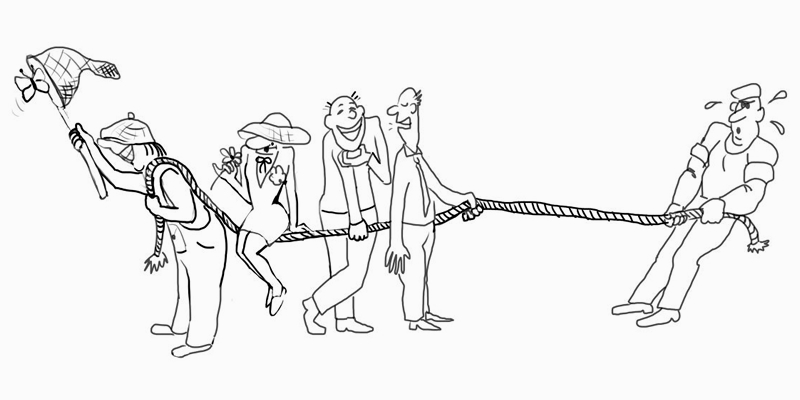
In the real working environment, the Ringelmann effect manifests itself in a variety of situations. One of the most typical examples is working on collective projects where there is no clear distribution of roles. In such cases, part of the team unconsciously slows down because they are confident that responsibility is shared among everyone. This often happens in large departments where one worker does not see the direct impact of their actions on the final result.
Another example is brainstorming sessions. Theoretically, they should stimulate activity, but in practice, the opposite often happens: a few people show initiative, while others retreat into a passive position. This is a classic manifestation of the Ringelmann effect, where participants do not feel obliged to actively engage.
In physical work, this phenomenon is also very noticeable. For example, when a large group of workers jointly carries heavy items, the majority of them unconsciously exert less force than they could. In corporate teams, the effect can manifest in reduced responsibility for documentation, routine tasks, or report preparation if no specific person is accountable for each of these tasks.
Thus, the Ringelmann effect is not an abstract theory but a real factor that influences team effectiveness in any field: from production to office work, from creative projects to volunteer initiatives. Understanding this phenomenon allows building systems that support individual responsibility and reduce the risks of hidden productivity decline.
How the Ringelmann Effect Influences Team Management?
The Ringelmann effect significantly impacts team management, as it can reduce the actual productivity of even the most talented specialists. When a manager works with a large team, they may notice that the final result seems less effective than expected from a collection of strong specialists. This does not always indicate low motivation or weak competencies – often, the reason lies in the mechanisms of group behavior that subtly diminish individual contributions. People can demonstrate high productivity in "solo" format but lose part of their energy when transitioning to a collaborative work mode.
For managers, this means that operational processes should be organized to maintain a sense of personal responsibility. If an employee does not see a clear link between their actions and the overall result, they begin to work less intensively. The influence of the Ringelmann effect is especially noticeable in teams where "collective anonymity" prevails: everyone does everything, and simultaneously, no one is specifically responsible for anything.
It is important for a manager to consider that increasing the number of participants does not automatically improve effectiveness. On the contrary, excessively large teams are more difficult to coordinate, make decisions slower, and each individual participant feels less psychological pressure regarding their contributions. In such conditions, the manager's task is to structure the work so that each person can clearly see their workload, know the deadlines, understand expectations, and receive constant feedback.

The managerial consequences of the Ringelmann effect also manifest in how project teams are formed. The manager should understand that increasing the number of people does not always lead to accelerated processes. Often, it is much more effective to create smaller but well-structured groups with clear distribution of responsibilities. This helps maintain motivation and reduces the risks of irresponsibility, as everyone’s contributions become visible.
Methods for Reducing or Overcoming the Ringelmann Effect
It is possible to reduce the impact of the Ringelmann effect by consciously fostering a culture of individual responsibility and transparency. One of the most effective methods is the clear assignment of roles and tasks to specific individuals. When an employee knows what exactly they are responsible for in a particular part of the work, the diffusion of responsibility disappears. A person understands that the result of their section can be measured, evaluated, and compared with expectations. This significantly boosts motivation.
The second method is the application of intermediate checkpoints. Even if the project is large and team-based, regular interim reports allow for assessing each individual's contributions. This approach is not a punishment; on the contrary, it provides a sense of support, allows for quick resolution of difficulties, and creates a feeling of steady progress.
Transparency in communication is also of great importance. If people understand how their work impacts the overall picture, they work more actively. It is vital to explain the value of each position in the team, emphasize the significance of individual contributions, and regularly acknowledge achievements. A simple "thank you" or highlighting that a specific result was made possible due to a particular expert's work increases engagement levels among all team members.
Another effective way is to work with team motivation. It is important to create an atmosphere in which each team member feels unity, mutual respect, and the value of the collective result. When employees see that their colleagues also work responsibly, they are less likely to retreat into a passive state. The opposite situation – when there are "free riders" in the team – provokes others to slow their pace.
The optimal team size is also crucial. For complex projects, sometimes a few specialists who clearly know their tasks are sufficient, rather than a dozen people with blurred functions. Smaller teams have a better sense of mutual responsibility and interact more effectively.
And finally, it is important to implement tools for evaluating results. If work is documented, analyzed, and discussed, the risk of social loafing decreases. People tend to work more actively when they know that their efforts will be noticed.
Common Mistakes in Evaluating Collective Productivity
A common mistake managers make is evaluating results solely at the team level without analyzing individual efforts. In such cases, the Ringelmann effect becomes even stronger, as employees understand that their personal contributions to the final result are not tracked. This creates conditions for the emergence of "hidden passivity," where some team members work less hard but remain unnoticed against the backdrop of the overall result.
Another typical mistake is increasing the team size without analyzing the actual need. Managers often believe that more people mean faster progress, but in practice, this can lead to slowdowns, loss of coordination, and decreased personal responsibility. An incorrect team size creates chaos, and chaos is fertile ground for the emergence of the Ringelmann effect.
The third mistake is an opaque system of roles. When tasks are not assigned to specific individuals, diffusion of responsibility begins to act. Participants may believe that someone else will complete the work, and as a result, the entire group suffers. This situation often arises in teams where there is no clear hierarchy or understandable project management.

The fourth mistake is the absence or weak feedback level. People lose motivation when they do not know whether their efforts have been noticed, whether results meet management's expectations, and whether the team is moving in the right direction. Without regular productivity assessments, employees may shift into a passive position, even without realizing it.
The fifth mistake is ignoring the team atmosphere. If there are those in the collective who consistently work less than others while receiving the same bonuses, the remaining team may unconsciously slow down. Failing to manage group dynamics creates conditions for the Ringelmann effect to become stronger.
Finally, it becomes a mistake to try to compensate for low productivity with additional control instead of optimizing processes. Excessive control can create tension and resistance but does not address the root cause: unclear roles, incorrect team sizes, poor communication, or the absence of clear goals.

Read also