European Donkey and the 2030 Mirage: Anatomy of Debt Illusion

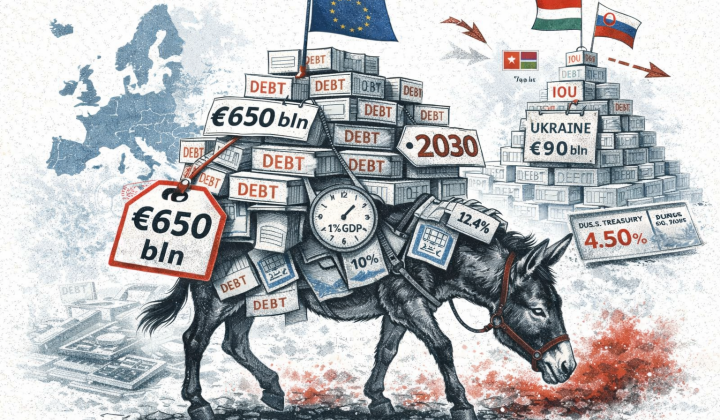
While tables are being prepared in Abu Dhabi for the 'liquidation commission', Brussels continues to play geopolitical planning for decades to come. The 'Readiness 2030' plan promises to turn Europe into a military fortress with a budget of €650 billion. But upon closer examination, this figure resembles not a foundation of security, but an attempt to build a pyramid of debt receipts.
Market Interest 'Pool' Loan
The European Commission offers not direct subsidies but permission for EU countries to violate fiscal rules and spend an additional 1.5% of GDP annually on defense. To give meaning to this plan, the SAFE instrument of €150 billion will be used.
-
Mechanics: Funds will be borrowed in open capital markets. However, against the backdrop of stagnation of the EU's industrial core and inflationary pressure, investors will demand a high risk premium. Why buy European bonds at 3.5% when U.S. Treasury bills under the current administration in Washington yield guaranteed 4.5%? As a result, the 'Fortress Europe' risks remaining without investors even at the foundation-laying stage.
Survival Loan: Where Will the 90 Billion Go?
The main financial news at the beginning of 2026 is a package of aid to Ukraine amounting to €90 billion for the period of 2026-2027. Behind this impressive figure lies specific accounting:
-
Debt Structure: Two-thirds of the amount (€60 billion) is aimed at military needs, while one-third (€30 billion) is for supporting macro-financial stability (social payments, pensions).
-
Source: Since the mechanism for using profits from frozen Russian assets remains legally complex, the EU issues joint debt secured by its own budget. Notably, Hungary, the Czech Republic, and Slovakia have already distanced themselves from this scheme. This is a 'loan for reparations' that Ukraine will formally be required to repay only after compensations from Russia. In fact, this is a debt obligation that hangs over the pan-European system.
The Philippine Paradox of Washington
The U.S. budget for 2026 set priorities with mathematical precision:
-
Ukraine: $400 million through the USAI program (for purchasing new weapons).
-
Philippines: $1.5 billion.
-
Taiwan: $1 billion.
The fourfold funding gap in favor of Manila is a clear signal: Washington has redirected resources to the Pacific region, considering it to be its direct area of interest. Ukraine, in turn, finally shifts into the category of 'Europe's responsibility', and the sums from the U.S. now seem more like a symbolic contribution than a real resource for conducting a large-scale war.
In Conclusion: When Credit Limits Expire
The European donkey, burdened with social obligations, energy prices, and new military loans, is barely standing. The problem with the '2030' plan is that it requires time and stability, which are absent.
When in Abu Dhabi the 'Auditor' from Washington presents the bill for the nuclear umbrella and demands immediate results, the paper billions of Brussels will confront the reality of an empty wallet. The real crisis will not come in 2030, but at the moment when trust limits in capital markets expire, and European governments find themselves with old weapons already distributed, and no physical capabilities or cheap money for new ones.

Read also