Physicists Develop a Method to Simulate Bird Flocks and Human Crowds


A Fresh Framework for Systems with One-Way Interactions
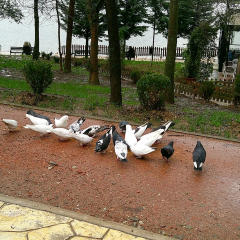
According to НВ — Техно: Researchers have introduced an innovative technique for modeling systems where interactions are one-sided-such as birds in a flock, cells, bacteria in colonies, or people in a crowd. The method involves adding auxiliary degrees of freedom in the form of imaginary partners, effectively converting these one-way interactions into two-way ones. This transformation then allows scientists to apply classic physics tools that were previously unsuitable for such scenarios.
For over 300 years, physics has relied on Newton’s third law, which states that every action has an equal and opposite reaction. Yet many natural systems do not follow this principle. For instance, birds in a flock primarily pay attention to those ahead of them and largely ignore those behind. Researchers, including Marin Bukov from the Max Planck Institute for the Physics of Complex Systems and co-author Rickard Alert, have created a theory that adapts classical approaches to handle these kinds of asymmetric interactions.
The Model and Future Research Directions
In this new model, each real element of the system is paired with a mathematical partner that exists only in calculations. This setup helps researchers examine how elements interact only with neighbors within their field of view. The method, designed for pairwise interactions between elements, offers deeper insight into the behavior of such systems.
“The team developed and proved a theory that makes many classic approaches applicable to systems with one-way interactions.”
Marin Bukov
Rickard Alert further emphasized that “for each component of the system, a fictitious partner is created-one that does not exist in nature.” Looking ahead, the researchers plan to investigate whether such systems could give rise to novel forms of collective quantum behavior.
This new approach to modeling systems with one-way interactions opens fresh avenues for research in physics and related fields. By using mathematical partners in studies, scientists may uncover new insights into the behavior of complex systems, with potential applications spanning biology to social sciences. It could ultimately reshape our understanding of collective behavior and how elements interact in both natural and technological settings.
In light of these advancements in modeling asymmetric interactions, it's worth exploring how recent breakthroughs have also challenged established theories in physics. For instance, a new study has successfully questioned Kolmogorov’s long-held principles regarding energy transfer, providing fresh insights into the complexities of physical systems. To find out more about this significant development, read our detailed coverage on the recent findings in energy transfer theory.

Read also