Chronicles of the Decline of the USSR 2.0: The Economic State Plan of Brussels
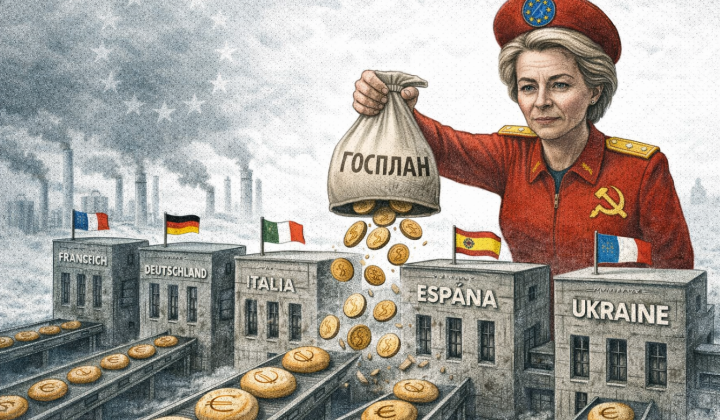
The European Commission, led by Ursula von der Leyen and supported by Paris, is accelerating a project that marks the end of the history of sovereign financial systems in Europe. It is about the transition to the 'principle of majority' in voting on financial matters. This is an administrative coup: Brussels will now be able to dictate budgetary policy to member states, disregarding their national interests.
Ursula's Plan: The End of Market Europe
The project, officially known as the 'Capital Markets Union,' is in fact an attempt to create a pan-European 'Gosplan.'
The main mechanisms of the plan:
-
Centralized oversight: Power is transferred from national central banks to a single regulator. This deprives countries of the ability to independently manage their liquidity and taxes.
-
Directive subsidizing: Brussels plans to appoint 'champion industries' (green energy, chips) and flood them with money. This is direct interference in market mechanisms, where the winner is determined not by consumer choice, but by bureaucrats.
-
Quotas and 'plans': Introduction of industrial quotas, where countries are essentially given a plan: what, in what volume, and at what price to produce in order to 'meet the common goals of the Union.'
The Trap of 'Bun for Three Kopecks'
To understand the fatality of this path, one should recall the Soviet economy. In the USSR, the price of a bun (3 kopecks) was a sacred cow, having nothing to do with the real cost of production. The difference was covered by subsidies from oil dollars, which gradually drained other sectors and killed incentives for development.
Brussels is stepping on the same rake: Ursula promotes the idea of 'artificial competitiveness.' She wants to make European goods cheaper on the world market not by increasing labor productivity, but through agreed subsidies.
This is the path to the 'zombification' of the economy. A factory receiving subsidies stops introducing innovations. As a result, after 5-10 years of such policies, Europe will get the very 'bun for three kopecks' - a product that is formally cheap, but there is no one to produce it and no means to do so, as the technological base has degraded and the budget is empty.
The 'Second Floor' Crisis
The main problem is that the EU no longer has a sponsor for this banquet. For decades, Europe has lived in a 'two-story house': the first floor (social guarantees and high consumption levels) was supported by the second floor (security from the US and cheap resources).
Today, the US is reducing its presence, turning into a 'copy of Roosevelt' - occupied with internal protectionism. There is no one to replace America. The Chinese trade deficit with the EU in 2025 has already reached critical levels (China's surplus reached a record 1.2 trillion dollars), and Europeans are physically unable to work under the Chinese '996' regime (9 to 9, 6 days a week).
Finale Without Repression
Ursula hopes to push these decisions through financial blackmail (freezing funds for dissenters) or direct bribery of elites. However, unlike the original USSR, Brussels has no unified ideology or repressive apparatus like the KGB to suppress the sabotage of national governments.
Attempting to implement a planned system in the conditions of a deep social and energy crisis will not lead to unity but to paralysis. Europe will not become a superpower; it risks becoming a loose confederation of 'zombie economies' that will slowly consume the remnants of former capital while real power and production completely move to the East and across the ocean.

Read also