Hubble Captures 2,500 Young Stars in the Large Magellanic Cloud

The Hubble Space Telescope and the LH 95 Region
According to НВ — Техно: The Hubble Space Telescope has delivered a fresh image of the LH 95 region within the Large Magellanic Cloud, an area where star formation is actively underway. Astronomers have identified roughly 2,500 young stellar objects that have nearly reached their full mass but have not yet ignited nuclear fusion in their cores. Observations indicate that the mass-gathering process is slower than previously thought, potentially lasting several million years. The Large Magellanic Cloud is a dwarf galaxy orbiting the Milky Way, making it an ideal laboratory for studying star birth in a nearby cosmic neighbor.
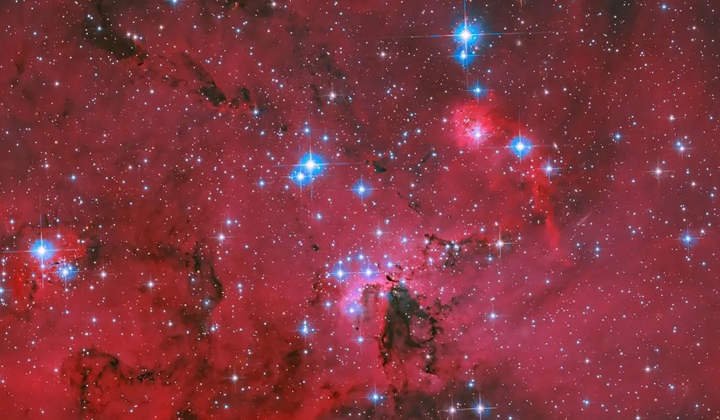
Located in the Large Magellanic Cloud, the LH 95 region is captured in the image with bright blue and white stars set against a backdrop of red hydrogen clouds. The red glow results from hydrogen emission, signaling active star formation. Dark lanes visible in the photograph are created by dense dust clouds. Stars in this area continue to contract under their own gravity, pulling in gas and dust from surrounding disks.
Star Formation in LH 95
Multiple generations of stars coexist simultaneously in LH 95. The most massive star in the region has a mass roughly 60 to 70 times that of the Sun, yet it is younger than most of its neighbors, which are about 4 million years old. This younger star is approximately one million years younger than its counterparts. LH 95 is a key target for studying stellar birth because it is relatively close and less obscured by dust than similar regions in the Milky Way, allowing astronomers to observe thousands of young stars at various developmental stages.
Radiant landscapes of gas and dust are heated and illuminated by the numerous young stars within the LH 95 region of the Large Magellanic Cloud. Research into this area opens up new avenues for understanding the processes of star formation both within our galaxy and beyond.
The findings from the LH 95 study underscore the importance of observing stellar nurseries across different galaxies, as this can broaden our knowledge of stellar evolution and influence future astrophysical models. Researchers hope that continued observations by Hubble and other telescopes will provide deeper insights into the mechanisms that shape star formation and the interactions between young stars and their surrounding environment.
As astronomers delve deeper into the mysteries of star formation, the James Webb Telescope's recent findings in the Orion Cloud provide a comprehensive view of stellar development across various stages. This comparison highlights the dynamic processes involved in star birth, offering insights that complement our understanding of regions like LH 95 in the Large Magellanic Cloud.

Read also