Hubble Captures Visible Light Image of the ‘Cat’s Tail’ Structure in Beta Pictoris System for the First Time

Revealing the ‘Cat’s Tail’ Formation
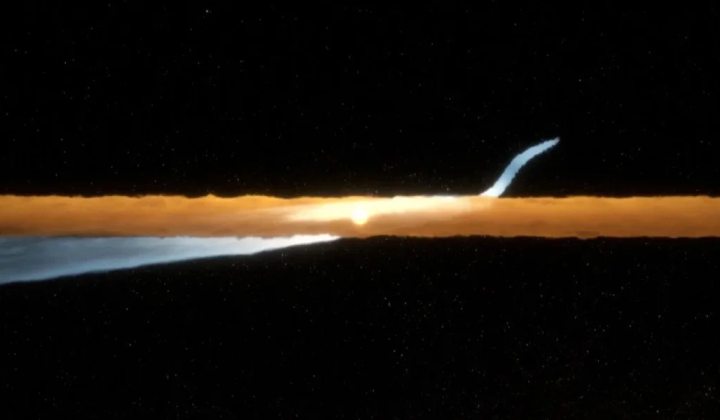
According to НВ — Техно: On November 3rd, astronomers using the Hubble Space Telescope achieved the first-ever visible-light observation of a feature known as the 'Cat’s Tail' within the Beta Pictoris star system. This breakthrough offers critical new insights into the composition and shape of the debris disk encircling the star, as well as the gravitational influence exerted by a massive planet on the surrounding dust.
The 'Cat’s Tail' stretches approximately 150 billion kilometers and is located in the Beta Pictoris system, which lies 63 light-years from Earth in the constellation Pictor. At around 20 million years old, this young stellar system hosts a disk of dust and debris left over from planet formation. The dust particles in the 'Cat’s Tail' mainly consist of organic carbon compounds and are about one micrometer in size. Their porous and fluffy nature likely contributed to the structure’s previous invisibility to telescopes operating at shorter wavelengths.
Astronomer Arin Avsar explains, "Long chains of carbon atoms absorb visible light, causing these particles to reflect very little of it."
Earlier estimates placed the 'Cat’s Tail' extending up to 1,000 astronomical units behind the star, but recent findings show it primarily spreads sideways in the plane of observation. The Beta Pictoris system also contains a gas giant, Beta Pictoris b, which has a mass roughly ten times that of Jupiter. This planet is one of three known planets orbiting the star. The gravitational pull from such massive planets influences the movement of comets, icy bodies, and dust over hundreds of astronomical units, a process reminiscent of what took place in the Kuiper Belt of our Solar System about 20 million years ago.
Observational Advances and Scientific Implications
Data collected over more than 14 years, combined with the recent Hubble observations, have refined our understanding of the 'Cat’s Tail’s' shape. The structure may have originated from a collision between large celestial objects roughly the size of Pluto. This discovery opens new avenues for exploring the complex dynamics within planetary systems and their role in planet formation.
Identifying the 'Cat’s Tail' in Beta Pictoris marks a significant advancement in studying how planets form and how stellar systems evolve. It highlights the crucial role that gravitational interactions between massive planets and dusty debris disks play in shaping planetary environments. These findings also offer valuable context for understanding the early stages of our own Solar System’s development.
As astronomers continue to explore the complexities of young star systems, findings from the Hubble Space Telescope are complemented by discoveries from the Webb Telescope. This advanced observatory has recently revealed intricate dusty environments surrounding young stars, providing valuable insights into the dynamics of planetary formation and collisions. For a deeper understanding of these celestial phenomena, check out how NASA's Webb Telescope is uncovering rare dusty systems.

Read also