Cassini Discovers Unexpected Shift in Saturn's Magnetic Shield

Unexpected Discovery by the Cassini Probe
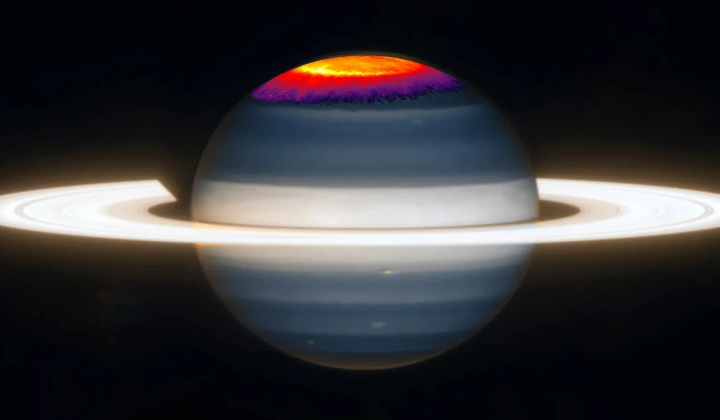
According to НВ — Техно: The rapid rotation of Saturn alters the structure of its magnetic shield. An analysis of archival data from the Cassini probe revealed that Saturn's magnetospheric cusp has shifted towards the evening side. This shift is a result of the planet's rapid rotation and the influence of ionized material supplied by the moon Enceladus. It is noted that this phenomenon differs from the behavior of Earth's magnetosphere. The study was published on August 10 at 19:30 in the journal Nature Communications.
Research of the Cassini Probe
The Cassini probe, a joint project of NASA, the European Space Agency, and the Italian Space Agency, studied the Saturn system in orbit from 2004 to 2017. Scientists analyzed data collected from 2004 to 2010 to investigate the behavior of the planet's magnetosphere. The research involved:
- Dr. Lisia Ray
- Dr. Sarah Badman
- Dr. Chris Arridge from Lancaster University
It is known that a day on Earth lasts 24 hours, and the magnetospheric cusp is near local noon. Whereas on Saturn a day lasts only about 10.7 hours, the cusp is generally shifted to a period between 13:00 and 15:00 local time, sometimes as late as 20:00. The reason for this shift is not only the rapid rotation of Saturn but also the high concentration of ionized material from Enceladus.
The study indicates that the internal pressure from rotation and the charged disc is a more significant factor in forming the magnetosphere than the external influence of solar wind. The cusp's shift is important for understanding the acceleration of high-energy particles, auroras, and magnetic reconnection. The results of this study could significantly alter scientists' understanding of the magnetospheres of planets in our solar system.
This discovery highlights the importance of studying the magnetospheres of planets, as they may play a crucial role in protecting atmospheres from cosmic radiation. Changes in Saturn's magnetosphere could affect its moons, particularly the potential for life on Enceladus, where a subglacial ocean has been discovered. Understanding these processes may also have broader implications for the study of other planets beyond our solar system.
This intriguing discovery about Saturn's magnetic shield invites comparisons with other celestial phenomena. For instance, recent research indicates that Earth’s inner core has also shown unexpected changes in its rotation direction, suggesting that planetary dynamics can be more complex than previously understood. Such findings could redefine our knowledge of planetary magnetospheres and their implications for space weather.

Read also