Only 16% of employees found conversations with managers meaningful

Effective Employee Evaluation
According to AIHR: The AIHR article discusses how HR managers can create specific and fair employee evaluations, including providing 150 examples of evaluative comments across eight areas. Effective evaluation, according to the materials, should answer three key questions: what specific behavior did the employee exhibit, what impact did it have, and what should happen next. It is important to focus on observed behaviors or measurable outcomes.
According to Gallup data, only 16% of employees found their last conversation with their managers meaningful. This indicates the need for a more detailed approach to evaluation. The article provides 150 examples of employee evaluations covering various areas, such as:
- communication
- teamwork
- quality of work
- problem-solving
- leadership
- reliability and attendance
- adaptability
- initiative
Strong evaluations involve not only formulating comments but also correctly adapting them to specific situations. For example, the phrase 'Needs to improve communication' may be insufficiently informative. Instead, specific feedback indicating that the employee would benefit from early warnings about project risks before deadlines are affected is much more useful.
Rules for Adapting Evaluations
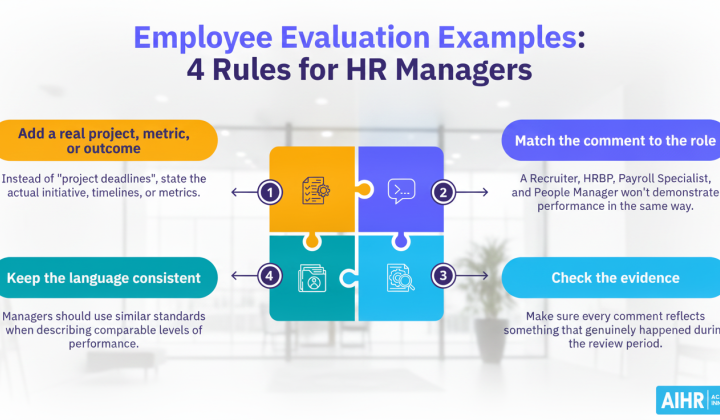
The article outlines four rules for adapting examples:
- add a real project or metric
- align the comment with the role
- check for evidence
- maintain consistency in language
A lack of consistency in evaluation can lead to distrust, resentment, and a decline in team morale. It is important to back up the evaluation with an example, ask for the employee's self-assessment, combine development areas with strengths, and describe the behavior, impact, and next steps.
Additionally, the article lists actions to avoid when evaluating:
- do not allow bias to influence the evaluation
- do not compare the employee with another by name
- do not use evaluations without evidence
- do not label personality traits
- do not ignore the context of the role
Evaluation should not be the only moment for feedback throughout the year.
Important aspects mentioned in the article also include the AIHR Talent Management & Succession Planning Certificate Program, as well as the CIPD guide on effective performance management. The final stage defined in the article includes skills in feedback, coaching, goal-setting, and evidence-based decision-making. This highlights the importance of a systematic approach to evaluation, which can significantly affect employee productivity.
The article emphasizes the importance of a structured and objective approach to employee evaluation in modern organizations. Considering the low level of employee satisfaction with feedback, the material presented could serve as a valuable tool for HR managers seeking to create a more effective evaluation system.
To improve employee productivity and avoid distrust in teams, it is essential to implement clear evaluation methods. As HR experts note, there are several strategies that can greatly enhance the feedback process. Learn about effective steps to enhance productivity and discover how to properly adapt evaluations to specific situations.

Read also