Astronomers Stunned by a Fresh Approach to Detecting Binary Black Holes


A Novel Technique for Locating Dual Supermassive Black Holes
According to НВ — Техно: A new study published in Physical Review Letters introduces an innovative method for detecting binary supermassive black holes using gravitational lensing. This strategy relies on the fact that paired black holes, which emerge after galaxies collide, generate a shifting diamond-shaped pattern known as a caustic curve. As the black holes orbit each other, this caustic curve warps and moves, producing brief flashes of light whenever it passes in front of a bright background star.
Gravitational lensing-a phenomenon that bends space and magnifies light-enables astronomers to observe these luminous bursts. By analyzing the frequency and intensity of the light fluctuations, researchers can determine the black holes' masses and orbital characteristics. This technique promises fresh opportunities for exploring and understanding binary supermassive black holes.
Future Prospects for Black Hole Research
To capture signals related to this effect, upcoming observatories such as the Vera C. Rubin Observatory and the Nancy Grace Roman Space Telescope will be deployed. This breakthrough could dramatically expand our knowledge of black holes and their influence on galaxy evolution.
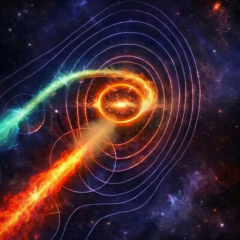
An illustration shows starlight (depicted in orange) being bent by the gravitational lensing of a supermassive binary black hole, highlighting the phenomenon underlying this novel astronomical method.
Applying this new approach to identify binary supermassive black holes could fundamentally shift our grasp of these enigmatic objects. At the heart of the research is the idea that next-generation observatories, capable of detecting light flares linked to gravitational lensing, are opening up new frontiers in astronomy-particularly regarding galaxy mergers and the evolution of the universe. This method may also aid in studying how black holes shape galaxy formation and development, a key topic in cosmology.
In addition to this groundbreaking method for detecting binary supermassive black holes, recent findings from the James Webb Space Telescope reveal a black hole that has outpaced the growth of its host galaxy. Such discoveries highlight the complex interplay between black holes and galaxy formation, providing further context for understanding these cosmic phenomena.

Read also