A 9-Step Guide to Building a Business Talent Map with Skill Ontology

Building a Talent Map for Your Business: A 9-Step Skill Ontology Guide
According to AIHR: Skill ontology is a critical framework for talent management, enabling organizations to create a structured map of employee capabilities that directly supports business objectives. Research indicates that companies which successfully implement skill-based practices are 63% more likely to achieve their business goals. With 38% of organizations now expecting to use a single, company-wide skills library, a well-defined ontology has become essential for optimizing talent processes. This structured approach is increasingly vital as the nature of work evolves, requiring a clear understanding of the skills within a workforce.
A comprehensive skill ontology is built upon eight core components:
- Skill entities (names)
- Definitions
- Interrelationships
- Skill hierarchy
- Proficiency levels
- Skill evidence signals (verification)
- Contextual tags
- Governance rules
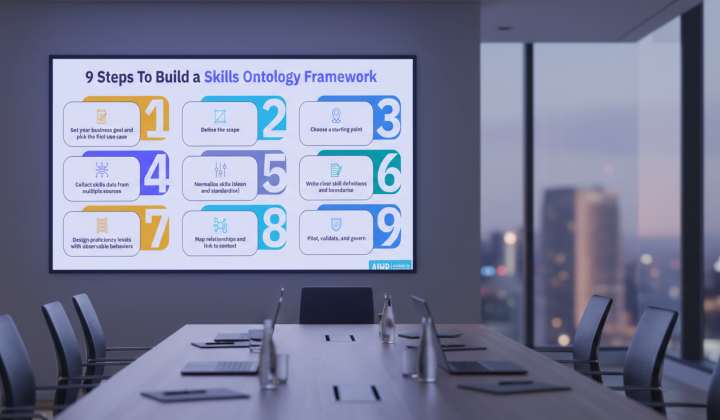
The construction of this framework follows a nine-step methodology. The initial step involves defining the core business goal and selecting the first use case. The subsequent steps are:
- Defining the scope
- Choosing a starting point
- Gathering skill data from multiple sources
- Normalizing the skills
- Writing clear definitions
- Developing proficiency levels
- Mapping interrelationships
- Applying contextual links
- Conducting pilot testing, validation, and ongoing management
Practical Applications of a Skill Ontology
In practice, skill ontologies are applied in six key areas. These include:
- Corporate skills platforms like Gloat and Eightfold
- Public standard frameworks such as O*NET, SFIA, and ESCO
- Internal talent marketplaces
- Recommended learning systems
- Skills-based hiring models
- Customer support career path maps
Data for building an ontology can be sourced from historical job descriptions, resumes of top performers, performance review criteria, project histories, Learning Management Systems (LMS), and insights from subject matter experts and manager interviews.
Overall, a skill ontology is a powerful tool that can significantly enhance business talent management by providing a structured approach to developing and utilizing employee capabilities.
Implementing a skill ontology allows organizations not only to improve HR efficiency but also to adapt to shifting labor market conditions. Given the constant evolution of technology and skill demands, companies using ontologies can respond more swiftly to change and ensure their workforce's skills remain aligned with current requirements. This strategic alignment can directly impact an organization's competitiveness within its industry.

Read also