Russia cannot penetrate Kyiv’s 95-meter deep underground shelters

Security Threats to Kyiv
According to Главком: Ukraine’s Defense Intelligence Directorate has obtained documents showing that Russia has identified underground facilities beneath Kyiv’s Government Quarter, located at depths exceeding 95 meters, as potential targets for missile and drone strikes. These findings reveal that Russian military objectives extend beyond central government buildings to include military command centers.
The acquired files document protected underground spaces in central Kyiv, including one situated directly under the Government Quarter. However, experts note that Russia’s ability to strike such targets with conventional weapons is limited. The world’s most powerful bunker-busting bomb, the GBU-57 Massive Ordnance Penetrator, can only penetrate up to 60 meters of earth. This bomb is dropped from high altitude by the B-2 strategic bomber, an aircraft Russia does not possess. Furthermore, the country lacks any equivalent to the GBU-57.
Limited Strike Capabilities
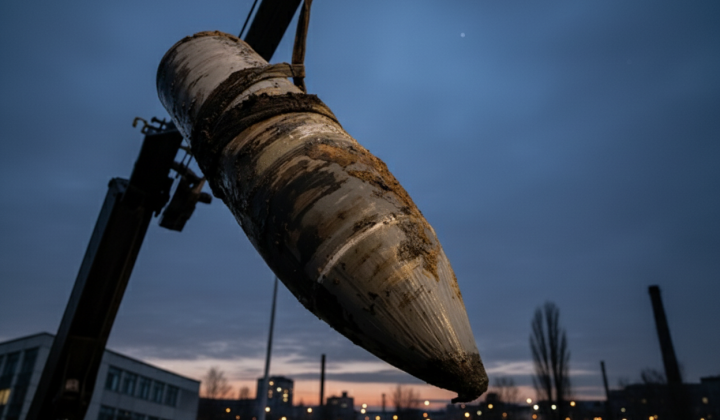
Russia’s most powerful known aerial weapon is the KAB-1500L-Pr, capable of penetrating 10 to 20 meters. However, deploying it requires an aircraft to be directly over Kyiv, which is virtually impossible. The only realistic conventional option for Russia involves concrete-piercing warheads for the 9M723 (Iskander) and Kh-47M2 (Kinzhal) missiles. Yet the 9M723 and Kh-47M2 carry a warhead based on the BetAB-500U bomb, which can only penetrate 3 to 5 meters of earth. This is insufficient, as the depth of Kyiv’s protected facilities exceeds that capability by twenty times.
Kyiv’s metro stations, located at deep and medium depths, are also beyond the reach of Russia’s ballistic and aeroballistic missile concrete-piercing warheads. The 9M723 missile has a launch mass of 3,800 kg and a warhead weighing 480 kg. In May 2025, propaganda media spread claims that Russian President Vladimir Putin ordered the identification of targets in Kyiv for a strike using the Oreshnik missile, but the actual ability to hit such fortified sites remains questionable.
The obtained documents highlight new security threats to Kyiv, but Russia’s limited capacity to strike deeply buried facilities suggests that while these targets may be strategically important, destroying them is highly challenging. This underscores the need to protect critical infrastructure and underground assets that could serve military purposes. Amid active hostilities, this intelligence could shape Ukraine’s defensive planning and international security support.
As the situation evolves, it's crucial to understand the broader context of recent military actions. Following Russia's extended strikes on Ukraine's critical infrastructure, the focus on Kyiv's fortified underground facilities highlights the challenges Russia faces in effectively targeting such deep shelters. This emphasizes the resilience of Ukraine's defense strategy amidst ongoing threats.

Read also