Boosting Productivity 2.6x: The Power of Weekly Employee Recognition

The Critical Role of Recognizing Employees
According to Achievers: Employee recognition programs are now essential for boosting both productivity and engagement. The 2025 State of Employee Recognition Report reveals that workers who receive praise every week are 2.6 times more likely to perform at their peak. Furthermore, weekly recognition makes employees nine times more likely to feel a strong sense of belonging within their team. This underscores how the frequency of positive feedback directly shapes a healthy workplace culture.
Data from the Workforce Institute's 2024 State of Employee Recognition Report confirms that employees recognized monthly by their peers are twice as likely to feel a strong sense of belonging and trust. Increasing recognition frequency from quarterly to monthly boosts the likelihood of engagement and productivity by 40%, while also raising job commitment by 25%. Those recognized monthly are 36% more likely to report high productivity and engagement, and 22% more likely to show strong dedication to their roles.
The Workplace Impact of Recognition
Gallup research indicates that employees who strongly agree with the statement 'I feel connected to my organization's culture' are 62% less likely to experience burnout and 47% less likely to seek another job. This demonstrates recognition's significant effect on overall job satisfaction. Meanwhile, 60% of HR leaders with an online recognition program report positive business outcomes, compared to just 30% of those using offline platforms. Programs that measure specific outcomes like well-being, belonging, and engagement are 68% more likely to deliver tangible business results.
Key stages in building an effective recognition program include:
- program design,
- program launch and introduction,
- measuring results and impact.
A robust recognition strategy rests on three pillars: social recognition, monetary rewards, and peer-to-peer acknowledgment. To gauge effectiveness, organizations should track metrics such as recognitions sent and received, monthly active users, activity levels, a recognition index, leadership participation, and improvements in engagement scores over time.
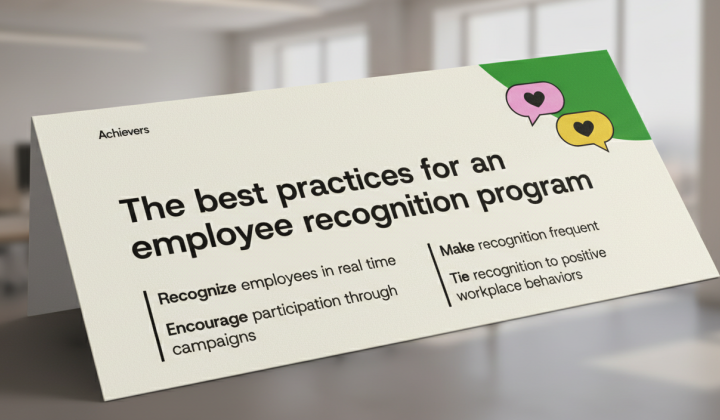
Best practices for recognition programs include:
- acknowledging contributions in real-time,
- driving participation through targeted campaigns,
- ensuring recognition is frequent and meaningful,
- tying praise directly to specific behaviors and achievements.
For global programs, it's vital to establish a unified global framework while making recognition culturally relevant and locally significant. This requires ensuring equity and worldwide access, empowering leaders and local champions, and launching initiatives globally with localized activation.
According to the State of Recognition Report, employees recognized by their managers are 19 times more likely to trust them and 11.7 times more likely to feel they belong.
Source: State of Recognition Report
In today's competitive talent market, employee recognition is a strategic imperative, directly influencing productivity, engagement, and retention. Companies that invest in high-quality recognition initiatives are better positioned to retain top talent and foster loyalty. Understanding the importance of frequency and method in recognition can be a decisive factor for a company's success amidst constant change. Integrating diverse recognition strategies can ensure sustainable growth and enhance an organization's overall competitiveness.

Read also