Per 100 Workers, How Many HR Staff Are Needed? Here’s What New Data Shows

Why the HR-to-Employee Ratio Matters
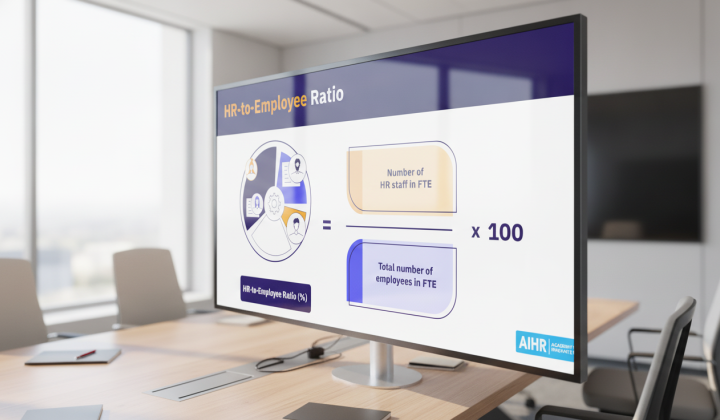
According to AIHR: Companies often ask how many HR professionals they need to support their workforce, and the HR-to-employee ratio is one of the key ways to measure that. This metric shows the number of HR staff allocated for every 100 employees, helping organizations assess whether their HR function is adequately resourced. The standard calculation is: (HR FTEs / employee FTEs) × 100.
Benchmark data from multiple studies suggests that the most favorable ratio usually falls between 1.5 and 1.7 HR professionals for every 100 workers. ADP Research Institute found that employee turnover tends to drop once organizations reach about 1 HR staff member per 200 workers, but then climbs if HR headcount goes beyond 9 per 200. In its research, Perceptyx reported that 33% of HR leaders said they feel physically and mentally drained, while 25% pointed to burnout as the growing complexity of their work took a toll over the past year.
How HR Functions Are Staffed in 2023
The fourth-quarter 2023 ADP at Work study put the average ratio at 2.6 HR professionals per 100 employees. Forbes gives a more granular picture: 3.4 per 100 in small companies, 1.22 in midsize firms, and 1.03 in large enterprises. SHRM’s Human Capital Benchmark Report places the average at 1.7 per 100, while CIPD’s survey of UK HR leaders found one HR professional per 60 employees. Bloomberg Law HR Benchmarks Report considers 1.5 per 100 to be typical, and Gartner’s figure is one HR FTE per 58 employees.
These benchmarks can look quite different in practice, as the examples below illustrate. A company with 2,045 employees (1,860 FTEs) and an HR team of 35 people (32 FTEs) ends up with a ratio of 1.7%. A smaller business with 55 workers and two HR staff has a ratio of 3.6%. A mid-sized firm with 380 employees (300 FTEs) and eight HR professionals (six FTEs) has a ratio of 2%.
A general staffing-needs table shows how recommended HR headcount scales with employee numbers:
- For 50 employees: 1–2 HR
- For 100 employees: 2–3 HR
- For 250 employees: 3–4 HR
- For 1,000 employees: 10–17 HR
In healthcare, common ratios are 1:30 to 1:50.
The key takeaway? There is no single perfect HR-to-employee ratio. The right number depends on company size, industry, organizational structure, digital maturity, and the actual role HR plays in the business.
When using this metric, it makes sense to tie it to business needs, factor in HR technology and outsourcing, and monitor changes over time.
Grasping the HR-to-employee ratio is essential because it directly affects how well people management functions and can help lower turnover. Since industries and company sizes vary so much, HR strategies need to be tailored to provide the proper support and resources for the HR team-which ultimately helps the organization meet its objectives. It’s also important to consider how modern technology and automation are reshaping the demand for HR staff.
Understanding the optimal HR-to-employee ratio is crucial, but it's equally important to recognize that manager relationships significantly influence employee engagement. A strong connection between employees and their managers can enhance productivity and retention, making it essential for organizations to foster these relationships alongside staffing their HR departments effectively.

Read also