James Webb Telescope Discovers a 'Monster' Galaxy That Defies Theories of Cosmic Evolution

Discovery of Galaxy M1149-BSG-z5
According to НВ — Техно: Astronomers have identified a galaxy known as M1149-BSG-z5, which existed less than 1.2 billion years after the Big Bang. This finding raises fresh questions about how structures formed in the early universe, as the galaxy features a stellar bar and spiral arms-contradicting theories that such elements require billions of years to develop. M1149-BSG-z5 is chemically mature, harbors a supermassive black hole, and has a companion galaxy nearby.
Key Characteristics of the Galaxy
M1149-BSG-z5 has a stellar mass of roughly 28 billion solar masses, indicating a strong capacity for new star formation. Stars in this galaxy are being born at a rate of about 145 solar masses per year. Its effective radius spans approximately 8,500 light-years, highlighting its enormous scale. A neighboring galaxy has also been observed about 70,000 light-years away from this giant.
A detailed report on the study of M1149-BSG-z5 was posted on the preprint server arXiv on July 8. This discovery underscores the importance of further exploring the early universe and the possibility that complex galactic structures formed much earlier than previously thought.
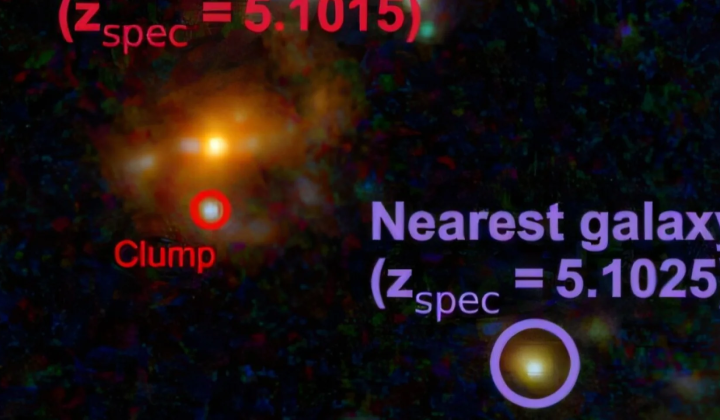
The positions of M1149-BSG-z5 and its likely companion galaxy reveal unique features that could deepen our understanding of galactic evolution in the early cosmos. (Image credit: Xiaohan Wang et al.)
The detection of M1149-BSG-z5 marks a significant step in studying the universe's evolution, as it challenges existing models of galaxy formation. This could lead to a rethinking of theories about when and how complex structures began to emerge in the universe, while also opening up new avenues for further research in this field. Investigating such early objects will help astronomers better grasp the processes that took place during the first billion years after the Big Bang.
The discovery of M1149-BSG-z5 invites further exploration into the life cycles of early galaxies. Understanding how stellar winds may have contributed to the premature demise of these cosmic structures can provide valuable insights. For a deeper look into how these winds influenced the evolution of ancient galaxies, read more about the impact of stellar winds on early galaxy formation.

Read also