Hubble Telescope Captures Sluggish Star Birth in the Large Magellanic Cloud

New Discoveries from the Hubble Space Telescope
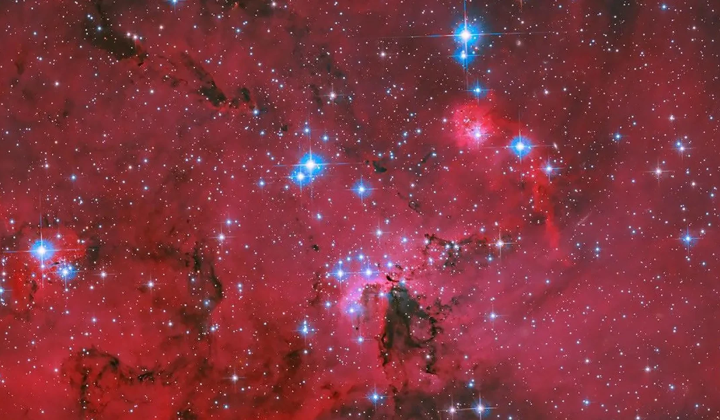
According to НВ — Техно: The Hubble Space Telescope has delivered a fresh image of the LH 95 region in the Large Magellanic Cloud, a site of intense star formation. Researchers have identified roughly 2,500 young stars, pointing to vigorous stellar birth processes within this galaxy. The picture reveals a glowing landscape of gas and dust, heated and illuminated by these numerous infant stars.
Distinctive Traits of the LH 95 Region
LH 95 sits in the Large Magellanic Cloud, a dwarf galaxy orbiting the Milky Way. Its most massive star weighs about 60 to 70 times the mass of the Sun. This star stands out because it is roughly one million years younger than most of its neighbors. The majority of stars found in this region are approximately 4 million years old.
Studies have shown that the accumulation of matter by young stars can stretch over several million years. This finding challenges previous assumptions about the speed of star formation in such environments. The observation results were published on July 6 at 1:30 PM, with the research reported by ScienceDaily.
This new view of the LH 95 area offers crucial insights into how stars form within dwarf galaxies, potentially helping scientists better grasp galaxy evolution and their role in the broader cosmos. Detecting such a large number of young stars and understanding the nuances of their formation could open fresh avenues in astronomical research and refine theories about star creation.
In addition to the findings from the Hubble Space Telescope, the James Webb Telescope has also provided valuable insights into star formation across various stages within the Orion Cloud. This comparison highlights the different environments and processes that contribute to stellar birth, offering a broader understanding of how these cosmic phenomena unfold throughout the universe.

Read also