Webb Telescope Unravels the Mystery of Neptune’s Moon Nereid

New Insights into Neptune’s Moon Nereid
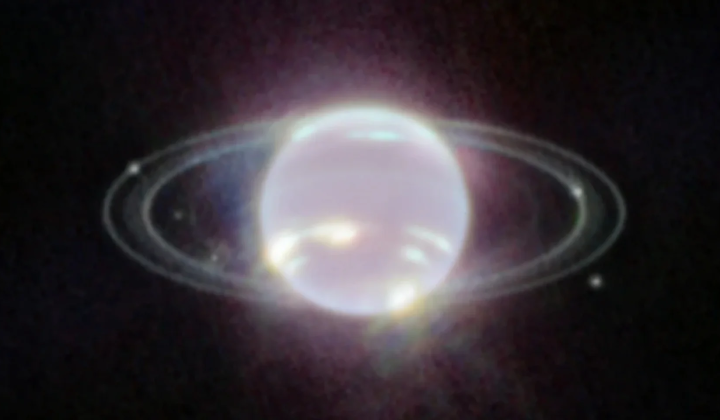
According to НВ — Техно: Using observations from the James Webb Space Telescope and computer simulations, researchers at the California Institute of Technology have proposed that Neptune’s moon Nereid is not a captured Kuiper Belt object. Instead, they suggest it is a surviving primordial moon of the planet, flung into an elongated orbit after Neptune captured another moon, Triton. This finding could significantly reshape our understanding of Neptune’s moon system and its evolution.
How Neptune’s Moons Evolved
Neptune stands out among gas giants due to its extreme axial tilt, which makes its moon system unique. Its largest moon, Triton, orbits in the opposite direction of Neptune’s rotation. Scientists believe Triton was once part of a binary Kuiper Belt object. Nereid, discovered by astronomer Gerard Kuiper in 1949, was the only known moon of Neptune besides Triton until the Voyager 2 flyby in 1989.
Nereid takes about 360 days to complete one orbit. In this new study, researchers pointed the James Webb Space Telescope’s infrared camera at Nereid for the first time. The moon’s spectral analysis does not align with a capture scenario from the early Solar System. Moreover, in 20% of their computer simulations, Triton ejected one of Neptune’s inner moons into a stable, highly elongated and inclined orbit-similar to Nereid’s current path.
These results open fresh avenues for understanding the origins and evolution of Neptune’s moons. They suggest Nereid may be a primordial moon that underwent dramatic changes due to dynamic processes within the system. The research continues, with scientists hoping further discoveries will clarify the complex nature of Neptune’s satellites.
This discovery highlights the importance of cutting-edge technology in astronomical research and its role in transforming our views of objects in the Solar System.
Researchers at the California Institute of Technology
Understanding the origin and evolution of Neptune’s moons not only deepens knowledge about the planet itself but also helps reveal the general principles of planetary system formation across the universe.
As researchers delve deeper into the mysteries of celestial bodies, similar studies have revealed intriguing insights about other moons in our solar system. For instance, the fascinating history of the destruction and rebirth of Uranus's moons showcases the dynamic processes that shape these distant worlds. Understanding these phenomena not only enhances our knowledge of Neptune’s moon Nereid but also places it within the broader context of moon evolution across the solar system.

Read also