Namibia’s First Crane-Free Wind Turbine Installed in Winds Reaching 20 m/s

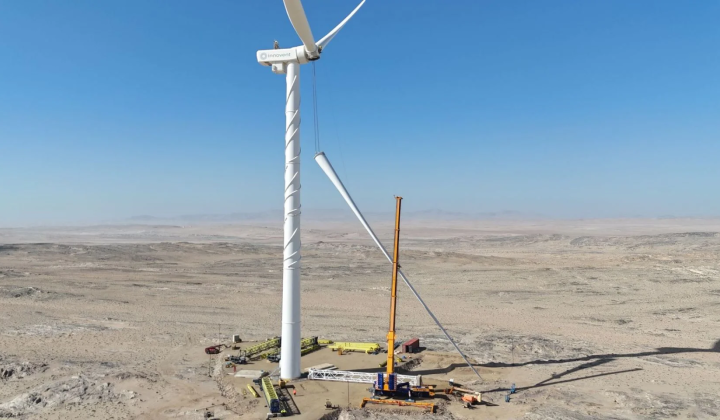
Milestone Installation in Namibia: Wind Turbine Erected Without a Crane
According to НВ — Техно: On June 2 at 10:01 AM, Nabrawind successfully installed the first-ever Goldwind GW165/6000 wind turbine-rated at 6 megawatts (MW)-at the InnoVent Diaz site in Namibia. What sets this project apart is the use of the Total Self-Erecting System (SES), a crane-free assembly method paired with Skylift technology. These innovations made it possible to mount the turbine in wind speeds of up to 20 m/s, a notable achievement given that conventional heavy cranes typically halt operations when wind speeds exceed 13.4–17.8 mph.
The installation took place under sustained winds of 33.5 mph, with gusts reaching 44.7 mph. The turbine’s main rotor was secured at a height of 98–131 feet (approximately 30–40 meters). In a novel approach for global wind energy, two rotor blades were attached to the hub on the ground at a 30-degree angle to the surface before lifting.
Game-Changing Potential of New Assembly Methods
The InnoVent Diaz wind farm is planned to consist of seven Goldwind GW165/6000 turbines, all to be assembled using the same crane-free technology. As representatives from Nabrawind noted,
'we aim to achieve a clean one-week installation cycle by the seventh turbine-all without hauling a massive crane across the desert.'
This highlights the efficiency of these new methods, which could dramatically simplify turbine installation in remote or difficult-to-access regions.
This project underscores the promise of cutting-edge renewable energy technologies, especially as demand grows for faster and more efficient turbine deployment. Given the challenging weather conditions during installation, the use of a self-erecting, crane-free system may represent a major step forward for wind energy development in areas facing similar obstacles.

Read also