Rare 66-Million-Year-Old Adult T. rex Footprints Discovered in North Dakota

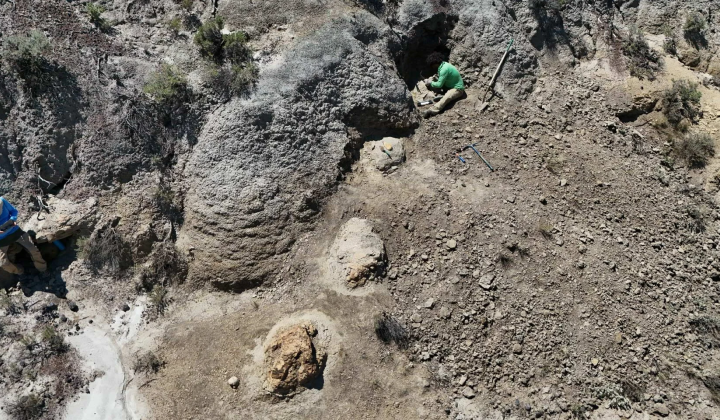
Remarkable T. rex Trackway Unearthed
According to НВ — Техно: Paleontologists working in North Dakota have uncovered a unique set of fossilized footprints belonging to an adult Tyrannosaurus rex, dating back approximately 66.5 million years within the Hell Creek Formation. This remarkable trackway features four massive three-toed prints, each nearly one meter in length, stretching across a total distance of about seven meters. Analysis of the spacing between these footprints suggests the dinosaur was moving at a pace of roughly 1.5 to 2 meters per second, with strides measuring close to four meters.
The Hell Creek Formation is known for its late Cretaceous deposits, formed just before the asteroid impact that led to the extinction of non-avian dinosaurs. While isolated T. rex footprints have previously been found-such as those discovered in New Mexico in 1994 and Montana in 2008-none have captured a continuous trail from an adult individual like this. The North Dakota prints are preserved as hardened sandstone molds, bonded by calcium carbonate cement, offering exceptional detail.
Kent Haps: 'As a teacher, I always tell my students that science begins with curiosity, passion, and careful observation. I never imagined it would lead me to such an extraordinary find.'
Insights from Recent Research
A collaborative study by University College London and the University of Cambridge, published in the Proceedings of the Royal Society B, examined 82 theropod species. The research highlights how tyrannosaurs independently evolved smaller forelimbs through at least five separate evolutionary events. This reduction is linked to the development of their massive, powerful skulls, which became their primary weapon, replacing the role of their arms. Their prey included enormous herbivorous sauropods, some reaching lengths of up to 30 meters.
Dr. Tyler Lyson: 'Bones provide us with a wealth of information about these creatures, but footprints capture a moment in their behavior. Through this trackway, we can actually follow the animal’s movement across the landscape. Such evidence is incredibly rare for a T. rex.'
This discovery enriches our understanding of dinosaur life and offers valuable new data for ongoing paleontological studies.
The unearthing of these T. rex footprints in North Dakota significantly enhances scientific knowledge of their locomotion and behavior. It also emphasizes the importance of combining traditional paleontology with modern scientific techniques. Finds like this have the potential to reshape our perspectives on dinosaur ecology and behavior during the final days before their extinction.
In addition to this fascinating discovery in North Dakota, paleontologists continue to unearth significant findings across North America. For instance, a remarkable fossil dating back 81 million years was recently identified in Canada, showing evidence of predator bites. This highlights the dynamic interactions between species during prehistoric times, further enhancing our understanding of the ancient ecosystems. To explore more about this intriguing find, visit the recent discovery in Canada.

Read also