320 Grams of Gold Among Bronze Age Treasures Discovered in Romania

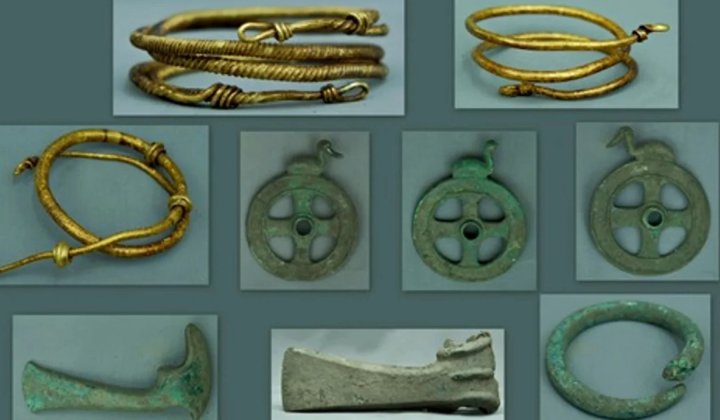
Bronze Age Hoard Unearthed in Romania
According to НВ — Техно: A remarkable Bronze Age hoard has been uncovered near the town of Urlați in Romania. The cache includes three gold necklaces, along with iron and bronze artifacts. The discovery was made by one of the roughly 1,000 officially registered metal detectorists in the region. The items were found on a hillside in a remote area with no roads or settlements, lying next to a large stone.
The first objects were located at a depth of 25 centimeters. Among them were three iron wheels, which had apparently been placed as a protective cover. Beneath these wheels, three heavy gold spirals were found.
Further Analysis and Significance of the Find
The day after the discovery, the detectorist handed the hoard over to the Prahova County Department of Culture. From there, the artifacts were transferred to the Prahova Museum of History and Archaeology. The total weight of the gold recovered is approximately 320 grams. At the bottom of the pit, two small axes and a bronze bracelet were also found. One of the necklaces features an ornament reminiscent of Bronze Age ceramic patterns, while the style of the other pieces points to silver artifacts from later periods.
Dr. Alin Frânculeasa, a doctor of archaeological sciences, described the find as 'exceptional' for the entire Romanian region.
Dating the artifacts is challenging, as the items span from the middle and late Bronze Age through to the early Iron Age. Archaeologists are currently working to determine the origin of the metal, and the hillside where the hoard was found is scheduled for detailed investigation during future archaeological excavations. Once expert analyses are complete, the treasures will be put on public display at the museum.
This discovery underscores the important role metal detectorists play in uncovering new archaeological artifacts. It also offers a valuable opportunity to further study the history of the Bronze Age in Romania. Examining the objects may shed light on the cultural and trade connections of that era, which is crucial for understanding the development of civilizations in the region.

Read also