How Supermassive Black Holes Trigger Star Formation in Nearby Galaxies

Shock Waves and Star-Forming Rings
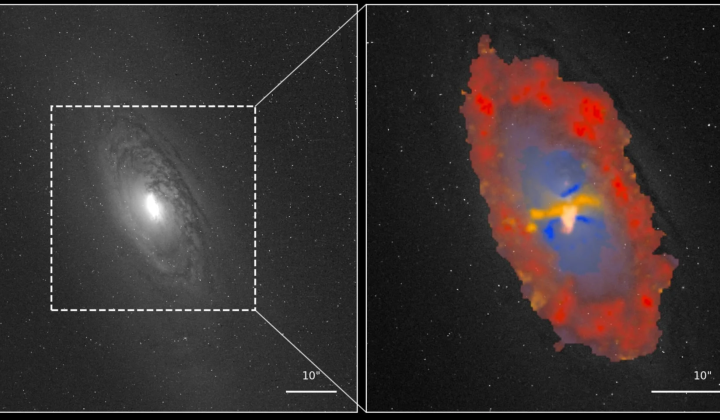
According to НВ — Техно: On September 15, a groundbreaking study published in The Astrophysical Journal examined nine nearby galaxies, revealing a transformative insight into the influence of supermassive black holes on cosmic evolution. Researchers demonstrated that actively growing black holes can actually promote the birth of new stars within their host galaxies. This conclusion was reached using data from ground-based observations with the VLT/MUSE instrument, alongside X-ray measurements from the Chandra Space Telescope.
A Novel 3D Diagnostic Approach
The team developed an innovative three-dimensional diagnostic technique that successfully distinguished between star formation, energetic emissions from active galactic nuclei, and shock waves. They discovered rings or arc-shaped regions of new stars forming at distances ranging from about 0.8 to 6 kiloparsecs from the galactic centers. These shock waves consistently propagate perpendicular to the large ionized cones of radiation emitted by the black holes, highlighting a complex feedback loop between the black hole and its surrounding environment.
Supermassive black holes at galactic centers do more than just consume matter-they also expel material outward, reshaping the nearby space. By combining optical data from MUSE with theoretical modeling, scientists traced the interactions between energy flows, gas, and young stars. This breakthrough challenges previous assumptions about galactic processes and emphasizes the crucial role of supermassive black holes in driving star formation.
These findings have far-reaching consequences for astrophysics, opening new avenues to explore galaxy evolution and dynamics. Understanding the mechanisms by which black holes influence star formation will enhance studies of our own Milky Way as well as other cosmic structures. This research also underscores the importance of integrating multiple observational techniques to deepen our understanding of the universe’s complex phenomena.
In addition to these findings, recent observations have revealed a remarkable event involving a black hole in the galaxy NGC 1275, where astronomers recorded its most powerful flare to date. This incident underscores the dynamic nature of black holes and their significant impact on their surroundings. To learn more about this extraordinary flare and its implications for our understanding of black hole behavior, read the full article on the powerful flare of a black hole.

Read also