How Roaming Black Holes Shape the Early Universe’s Evolution

Hidden Clues from the Universe’s Earliest Epochs
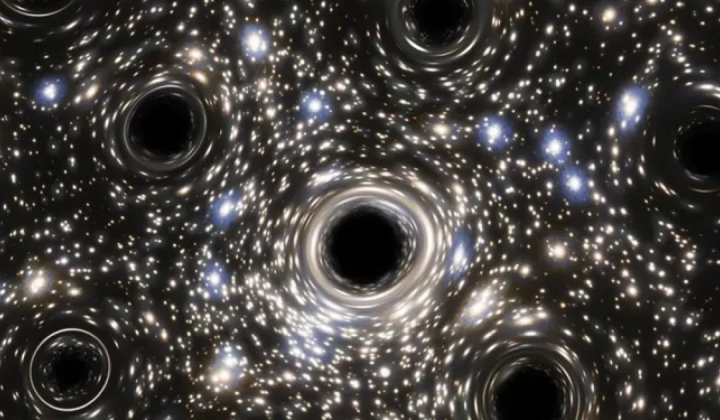
According to НВ — Техно: Researchers at Yale University have uncovered how black holes that wander beyond their host galaxies influence the cosmic evolution. These traveling black holes, ejected from their galactic centers due to cosmic collisions, carry vital clues about the formation of the very first stellar systems. Understanding their behavior could help resolve ongoing debates about the origins of supermassive black holes during the universe’s infancy.
The study reveals that smaller galaxies, with their weaker gravitational pull, are more likely to lose black holes from their cores. This insight is crucial for understanding how galaxies evolve over time. The team used the ASTRID cosmological simulation, which models 13.5 billion years of cosmic history and tracks galaxies ranging in mass from 10 million to 1 billion times that of the Sun.
Wandering Black Holes and Their Role in Star Formation
Findings indicate that in smaller galaxies whose centers remain stable, star formation halts earlier compared to galaxies where black holes roam freely. This suggests that these nomadic black holes could play a significant role in triggering or sustaining new star formation within their galaxies. The question of how supermassive black holes first formed remains a hotly debated topic, with two main hypotheses:
- Light seeds originating from the collapse of the first massive stars;
- Heavy seeds formed through the direct collapse of gas clouds.
"Incorporating wandering black holes alongside central ones is essential for fully grasping the origins, dynamics, and evolutionary history of their host galaxies."
Emma Jane Weller
The research team combines advanced computer simulations with data from optical and X-ray telescopes to probe the early universe's development. Priyamvada Natarajan emphasized, "Black holes hold memories far beyond their birth conditions. Their current locations reflect the entire history of their host galaxies' formation."
This breakthrough has the potential to transform our understanding of cosmic evolution, particularly the intricate relationship between black holes and galaxies. Clarifying the influence of wandering black holes on star formation could inspire further investigations, deepening our knowledge of the universe’s dynamics. Moreover, these findings may significantly impact theories about the origins of supermassive black holes, opening new avenues for scientific exploration and debate.
The interplay between black holes and star formation is complex and crucial for understanding galaxy evolution. Research indicates that supermassive black holes can significantly influence the birth of new stars in nearby galaxies. This connection highlights the importance of studying both roaming and central black holes to uncover the mechanisms driving cosmic development.

Read also