Star Caught Devouring an Entire Planet, Astronomers Reveal

Lithium Discovery in Star TOI-5882
According to НВ — Техно: A star known as TOI-5882 has been found to contain unusually high levels of lithium, a strong clue that it may have swallowed a planet. Published on July 17, 2026, the study suggests the consumed world weighed anywhere from a few Earth masses up to that of Neptune. Compared to 62 other stars of similar age, mass, and temperature, TOI-5882 ranks in the top 3% for lithium concentration. The research team also noted that several other stars in the comparison group showed elevated lithium levels as well.
How a Planet Gets Consumed
The process of a star absorbing a planet unfolds over just days or weeks. Astronomers explain that planets contain far more lithium than stars do. This backs up the words of Brook Cotten:
'Planets have much more lithium than stars. So when a star engulfs a planet, it gains an extra supply of this element.'
Additionally, a brown dwarf with a mass exceeding 20 Jupiters orbits TOI-5882. Therefore, the detection of excess lithium in this star may point to active, ongoing events within its system.
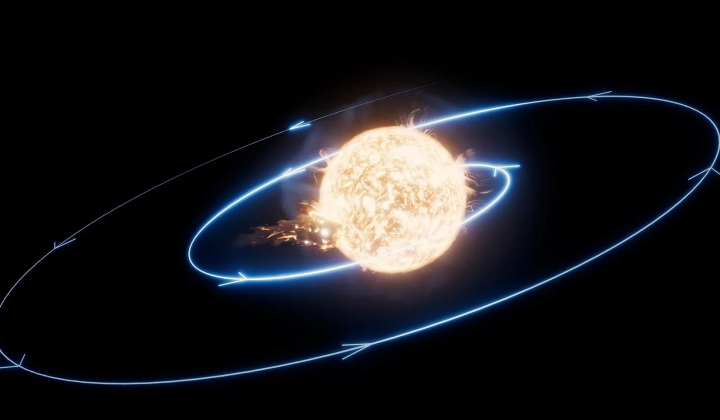
Interestingly, in about 5 billion years, our own Sun will consume Mercury, Venus, and possibly Earth. This highlights the ever-changing, dynamic nature of the universe, where stars and planets constantly interact. An illustration of a star devouring a planet shows this complex dance: a blue line marks the planet's spiral path as it draws closer and ultimately collides with the star.
These findings open new avenues for studying not just stars but also the planetary systems throughout our galaxy. ScienceDaily covered the discovery.
The detection of elevated lithium levels in TOI-5882 could reshape how we understand the formation and evolution of star systems. This research not only underscores lithium's value as a marker for planetary ingestion but also points to fresh directions for exploring how stars and their planets interact. Given that similar events may occur in other star systems, it could help scientists better grasp galactic dynamics and the broader evolution of planetary systems.
The dynamics of stellar evolution are complex, and understanding how stars interact with their surrounding planets can provide valuable insights into our own solar system's future. For instance, while TOI-5882 has been found to consume planets, our Sun's eventual transformation into a red giant raises questions about Earth's fate. To explore how our planet might escape being engulfed by the Sun during this transition, read more about it here.

Read also