12 AI Skills HR Professionals Must Have to Get Hired

The Critical Need for AI Skills in Human Resources
According to AIHR: Artificial intelligence skills are now a non-negotiable requirement for human resources professionals. Research indicates that 66% of business leaders would not hire an HR candidate who lacks AI competencies. This trend underscores the growing importance of AI knowledge for a successful career in people management. Furthermore, 71% of leaders would actually prefer a less experienced candidate if they possess AI skills, highlighting the premium now placed on this expertise.
Soaring Demand for AI Competencies
The demand for generative AI skills in non-tech industries has skyrocketed by 800% over the last three years. This surge demonstrates that AI proficiency is increasingly sought after far beyond the IT sector. Notably, over half of all job postings requiring AI skills are now outside of IT and computer science fields. These AI-skilled roles command salaries 28% higher on average, equating to nearly $18,000 more per year, providing a significant financial incentive for professionals to upskill.
This shift is driven by pressure from the top: 74% of CEOs believe their own positions are at risk if they fail to deliver measurable results from AI investments. Companies with robust AI infrastructure are outperforming their competitors in shareholder value by a factor of two to six. At companies like Zapier, this adoption is happening rapidly, with 97% of employees now using AI in their daily work, a transformation achieved in under two years.
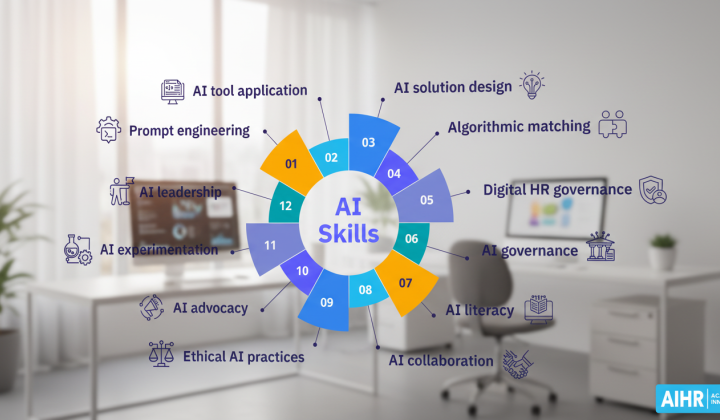
For HR professionals, there are 12 key types of AI skills that are crucial to highlight on a resume. These include:
- Prompt Engineering
- AI Tool Application
- AI Solution Design
- Algorithmic Curation
- Digital HR Management
- AI Governance
- AI Literacy
- AI Collaboration
- AI Ethical Practice
- AI Advocacy
- AI Experimentation
- AI Leadership
To illustrate, 'Prompt Engineering' involves designing and refining queries for specific HR use cases, creating reusable prompt templates, and translating complex business problems into thoughtful, scalable inputs for AI systems. In 'AI Tool Application,' key skills include selecting and applying AI tools for specific HR processes, evaluating their outputs for accuracy and relevance, and integrating these tools into existing HR systems and workflows.
In today's business environment, AI skills have become an indispensable component of the HR professional's toolkit. As technological progress accelerates, organizations are compelled to adapt their hiring and development strategies to remain competitive in the talent market. This evolution may necessitate a fundamental rethinking of HR training programs and professional standards to meet the demands of the modern workplace, where AI competency is no longer a bonus but a baseline expectation.

Read also