A 14-Kilometer Hidden Layer Discovered on Mars Is Reshaping What Scientists Know About the Planet

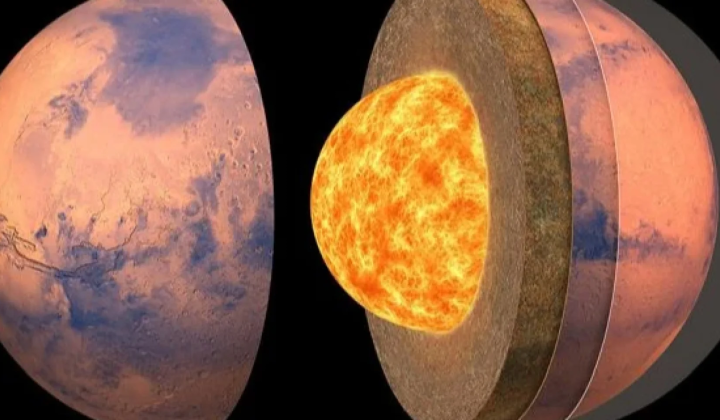
Uncovering Mars’ Magmatic System
According to НВ — Техно: On June 27, 2023, an international research team led by seismologist Taubemori McKay-Champion from the University of Bristol published their findings in the journal Nature Astronomy. Their study revealed that Mars possesses a complex transcrustal magmatic system, pointing to long-lasting volcanic processes previously thought to occur only on Earth.
These insights were made possible by data from NASA’s InSight lander, which concluded its mission and lost contact in 2022. Over four years stationed on the Elysium Planitia, the probe recorded 1,319 marsquakes, allowing scientists to probe the planet’s interior. The research identified an ultramafic lower layer roughly 14 kilometers thick, rich in iron and magnesium. Above this lies a mafic rock layer with a high silica content.
Why These Findings Matter
The researchers also noted that processes such as prolonged magmatism, volatile cycling, and stable heat transfer can occur on rocky planets without plate tectonics. This discovery could fundamentally change our understanding of geological activity on other planets, particularly Mars.
An illustration of Mars’ internal structure (Credit: IPGP/David Ducros) underscores the significance of data from NASA’s InSight mission and its contribution to planetary geology research.
The study continues to unlock the Red Planet’s secrets and highlights the importance of international collaboration in scientific exploration.
These results open new avenues for studying Martian geology and potential parallels with Earth’s own processes. They may also influence future missions to the Red Planet, particularly in the search for life and the assessment of potential resources. The work of NASA’s InSight mission underscores the value of technology and global cooperation in exploring other worlds in our solar system.
In light of these groundbreaking findings, understanding Mars' geological history becomes increasingly vital. Recent discoveries of complex organic compounds on the planet have further fueled scientific interest, suggesting the potential for past life and resource utilization. Together, these studies are reshaping our perspective on the Red Planet's potential for habitability.

Read also