NASA’s ERNEST Mars Rover Prototype Achieves Record-Breaking Speed

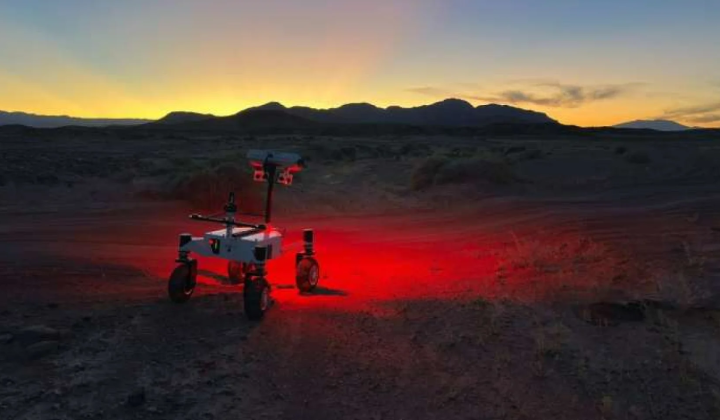
Meet ERNEST: A Next-Generation Rover Prototype
According to НВ — Техно: NASA’s Jet Propulsion Laboratory in Southern California has developed a new rover prototype named ERNEST, short for Exploration Rover for Navigating Extreme Sloped Terrain. Designed to enhance autonomy and traction on steep inclines, the 1.2-meter-long vehicle features an active suspension system that can individually lift each of its wheels. Over a seven-day testing period, ERNEST covered ground at speeds up to 1 km/h during 37 hours of movement-an order of magnitude faster than the maximum velocities of NASA’s Perseverance and Curiosity rovers, marking a significant leap in planetary mobility.
The project initially aimed to create a relatively simple and low-cost rover. Before arriving at the current version, the team built two earlier prototypes, each roughly 0.6 meters (2 feet) long. They also evaluated 11 different active suspension configurations, which greatly improved the prototype’s driving performance.
Why These Tests Matter
According to developer Issa Nesnas,
“this testing helps us refine hardware for mobility and software for autonomous navigation over extreme distances across a wide range of terrain and lighting conditions expected on the Moon.”
Team member James Keane added,
“you could take a science traverse across the Moon or Mars with this vehicle.”
Separately, the Curiosity rover experienced an incident on April 25, 2026, when it drilled into a rock called Atacama during its ongoing Mars mission. Now in its 13.5th year on the Red Planet, Curiosity continues to carry out critical scientific tasks; during this particular drilling operation, it lifted a 13-kilogram stone slab.
ERNEST represents a major step forward in autonomous rover technology, with potential applications in future lunar missions. The team’s next goal is to build a rover twice the size of the current prototype. These advancements open new frontiers in space exploration, enhancing the ability of robotic vehicles to operate independently in extreme environments.
The development of ERNEST is a key component of NASA’s broader Moon and Mars exploration strategy. Autonomous rovers are expected to play a vital role in upcoming missions, and ongoing improvements-such as active suspension and self-guided navigation-are making it increasingly feasible to explore uncharted territories. This underscores the growing importance of automated systems in space exploration, which can reduce risks for human missions in remote regions of the solar system.
As NASA continues to push the boundaries of planetary exploration, recent developments highlight both advancements and challenges in rover technology. While the new ERNEST prototype showcases remarkable speed and autonomy, the recent termination of the MAVEN mission due to critical failures serves as a reminder of the complexities involved in space missions. Understanding these dynamics is crucial for future explorations.

Read also