Discovery of Garnet in Martian Meteorite NWA 8171 Sheds New Light on Mars' Geological Past

The Geology of the Red Planet
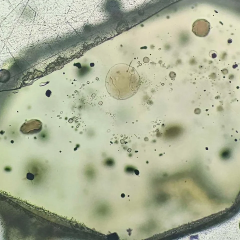
According to НВ — Техно: Scientists have identified an unusual mineral in a Martian meteorite for the first time. Garnet was detected in the Martian meteorite NWA 8171, marking a significant breakthrough in understanding Mars’ geological history and mineral formation processes. This meteorite, part of the Royal Ontario Museum’s collection, contains a garnet fragment measuring approximately 0.8 by 0.5 millimeters.
Initially mistaken for pyroxene due to its yellow-green hue, further chemical analysis revealed the mineral to be andradite-a type of garnet rich in iron. On Earth, garnets typically form under conditions of high temperature and pressure or through interactions with hot fluids. This suggests that the garnet found in the Martian meteorite may have originated from magmatic activity or metamorphic processes on Mars.
How Garnet Could Have Formed
Researchers propose two potential formation scenarios for the garnet:
- The meteorite’s impact with the Martian surface;
- The ascent of magma through Mars’ crust.
NWA 8171 consists of basaltic breccia, a rock made up of fragmented minerals cemented by basalt. Future studies aim to analyze the isotopic composition of the garnet to confirm its Martian origin.
This meteorite is one of 18 fragments from a single fall, with the most famous being known as the "Black Beauty" (NWA 7034). The discovery was detailed in a Science Alert article published on November 27, 2026. Tanya Kizovski, a lead researcher, explained,
“The mineral likely formed through unusual magmatic processes or metamorphism-where rocks are transformed by intense heat, pressure, or hot fluids.”
Uncovering garnet in the NWA 8171 meteorite represents a vital advancement in Mars research. It offers scientists a clearer window into the planet’s past surface conditions and geological events. By examining the isotopic makeup of the garnet, researchers hope to gain deeper insights into the environmental factors that shaped it, enhancing our understanding of Martian geology. This finding holds promising implications for future planetary science and astrophysics studies.
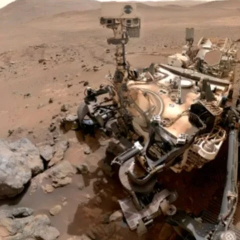
The discovery of garnet in the Martian meteorite NWA 8171 not only enhances our understanding of Mars' geological history but also aligns with other significant findings on the planet. For instance, the Curiosity Rover's recent identification of ancient sulfur deposits further illustrates the complexity of Mars' past environments and the processes that shaped its surface over billions of years.

Read also