KAIST HOUND Robot Learns to Shift Its Running Style Mid-Obstacle

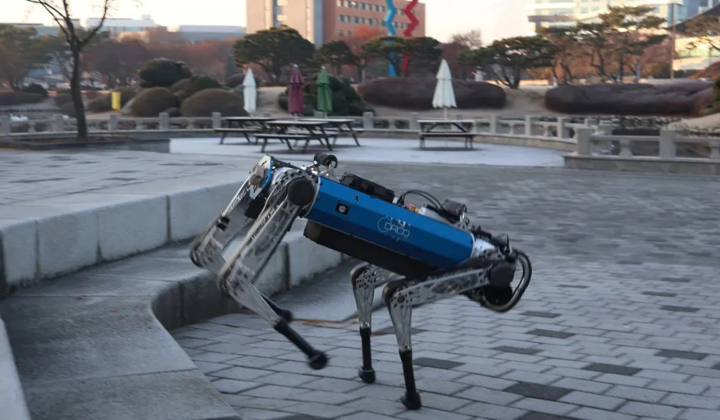
Introducing the KAIST HOUND Robot
According to НВ — Техно: On July 16 at 4:30 PM, researchers unveiled a four-legged robot named KAIST HOUND. Thanks to a new artificial intelligence training system called APT-RL, this machine has learned to alter its running gait while navigating obstacles. Weighing 45 kilograms, its design enables it to efficiently move through challenging real-world environments, including staircases.
KAIST HOUND uses cameras and lidar to scan the ground, allowing it to adapt its movements to surrounding conditions. During outdoor trials, the robot successfully completed a 1.1-kilometer route across a university campus. It also traversed a 0.3-kilometer forest path littered with roots, logs, and slippery leaves.
Training Platform and Achievements
The research team developed a training platform known as 'transformer-based reinforcement learning,' which was pre-trained on actions (APT-RL). For the training phase, they created 180,000 short sequences of trotting and jumping, representing roughly 15.5 hours of robot motion. Generating this dataset took about eight minutes.
In one indoor test, KAIST HOUND jumped over a 60-centimeter obstacle, briefly reaching a speed of 15 km/h during the leap. The robot also hopped down a three-step staircase, showcasing its adaptability.
KAIST HOUND thus stands as a testament to new possibilities for artificial intelligence in robotics, confirming that technology can greatly enhance robot mobility and efficiency in complex conditions.
The development of KAIST HOUND highlights the importance of integrating AI into robotics, opening new horizons for robot applications in fields ranging from rescue operations to exploring hard-to-reach areas. As automation and technological innovation advance, projects like this could lay the groundwork for creating more sophisticated and adaptive systems capable of tasks that once required human intervention.

Read also