AI's $4.4 Trillion Economic Boost: Why Employee Training is HR's Top Priority

Building an AI-Skilled Workforce
According to AIHR: In today's business landscape, equipping employees with artificial intelligence (AI) skills has become a central mission for Human Resources departments. According to McKinsey, the widespread corporate adoption of generative AI could inject up to $4.4 trillion annually into the global economy through productivity gains. Despite this immense potential, a mere 1% of business leaders consider their companies 'mature' in AI implementation. This stark gap underscores the critical need for developing in-house AI competency to maintain a competitive edge. For context, this projected economic impact is comparable to adding the entire GDP of a major nation like Germany to the global economy each year.
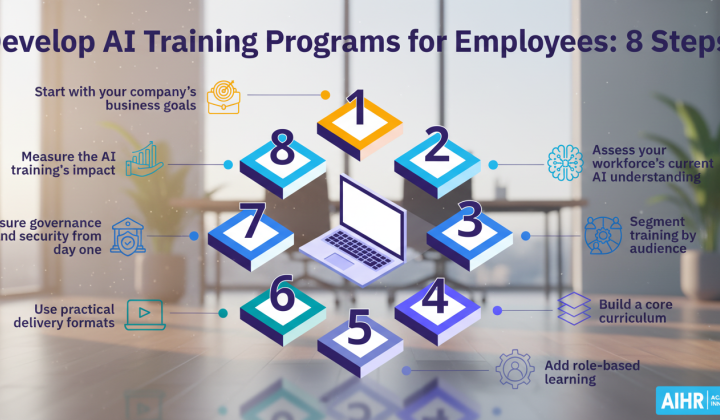
To manage this upskilling effectively, HR teams must first build their own AI literacy. Training programs should be strategically designed around specific company objectives. Key steps for developing these initiatives include:
- Aligning training with core business goals,
- Assessing the current AI understanding among staff,
- Segmenting the audience for tailored learning,
- Creating a foundational core curriculum,
- Adding role-specific training modules,
- Utilizing hands-on, practical delivery formats,
- Integrating governance and security principles from the start,
- Measuring the business impact of AI training.
Recommended courses to build this capability include the 'Artificial Intelligence for HR certificate program' from AIHR for HR professionals, Google's 'Prompting Essentials' for all employees, and 'Generative AI for Everyone' on Coursera for non-technical roles. Additional programs are offered by major tech players like Microsoft, AWS, IBM, Salesforce, and OpenAI Academy.
Overcoming AI Training Implementation Hurdles
However, rolling out AI training is not without significant challenges. Common obstacles include uncertainty about where to begin, low employee confidence or resistance, ineffective one-size-fits-all programs, lack of leadership support, security and compliance concerns, an inability to measure training impact, and general learning fatigue. Successfully navigating these hurdles is essential for companies to fully integrate AI into their operations and reap its benefits.
Developing AI skills is now crucial for any organization aiming to stay relevant amid rapid technological change. Effective training in this area does more than boost productivity; it builds business resilience for future market shifts. Given the substantial economic forecasts, companies that proactively invest in upskilling their workforce are positioning themselves for significant long-term advantage.
As organizations strive to enhance their workforce's capabilities, the integration of AI into employee onboarding processes is becoming increasingly vital. This transformation not only accelerates adaptation but also significantly reduces the time required for new hires to become productive members of the team. To explore how AI can streamline the onboarding experience and further revolutionize HR practices, read more about the impact of AI on employee adaptation here.

Read also