Roman Legionary Iron Tools and Hasta Spearhead Unearthed Near Perperikon, Bulgaria

Functional Tools or Weapons?
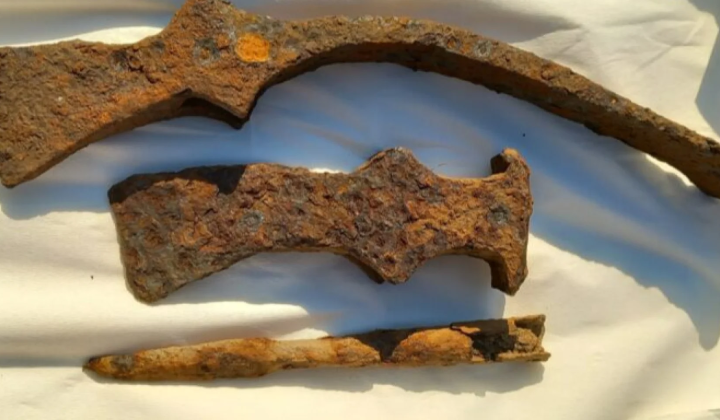
According to НВ — Техно: Archaeologists working close to the ancient 1,700-year-old Roman fortress of Perperikon in Bulgaria have uncovered two remarkably preserved iron tools used by Roman legionaries-dolabrae-as well as an iron spearhead of the hasta type. These discoveries shed light on both the practical and combat-related aspects of Roman soldiers’ daily lives and enrich our understanding of their engineering expertise.
Details of the Finds
The dolabrae found at Perperikon feature a blade resembling an axe on one end and a pointed or hammer-like surface on the other, with a central hole designed for attaching a wooden handle. The term "dolabra" originates from the Latin verb dolare, meaning to cut or hew. These versatile tools were employed for multiple purposes, including:
- chopping wood
- digging trenches
- constructing fortifications
- occasionally serving as weapons in combat
The Roman historian Tacitus documented the use of axe-like and pick-like tools similar to the dolabra during the Gallic uprising in 21 AD, noting their role in breaching enemy armor.
In addition, the team uncovered a well-preserved iron spearhead classified as a hasta, designed to be mounted on a wooden shaft approximately 2.4 meters long-commonly made from ash wood. Unlike the pilum, which was thrown, the hasta functioned as a long thrusting spear. Previous finds in and around Perperikon include iron wedges and stone implements used to split large rock blocks for architectural construction.
Roman legionaries were responsible for a broad range of engineering and logistical tasks essential to establishing secure camps: clearing vegetation, digging defensive ditches, building earthen embankments and palisades, preparing tent sites, and ensuring supplies of water and firewood. Furthermore, archaeologists have uncovered a Roman inscription dated to the early reign of Emperor Trajan (98–117 AD) at the nearby thermal complex of Aquae Calidae near Burgas.
"These multi-purpose tools enabled legionaries to fell timber, excavate trenches, build fortifications, and even fight when conventional weapons proved inadequate." – researchers
The discovery of these iron tools linked to Roman legionaries in Bulgaria highlights the strategic significance of this region for examining Roman military and construction activities. The artifacts not only demonstrate the soldiers’ engineering skills but also provide valuable insights into their everyday routines. This find opens new avenues for archaeological and historical research, particularly concerning the expansion of Roman frontiers and their impact on local cultures.

Read also