A Unique Stamp Found in England Could Rewrite the History of the Sutton Hoo Helmet

A Major Discovery by a Metal Detectorist
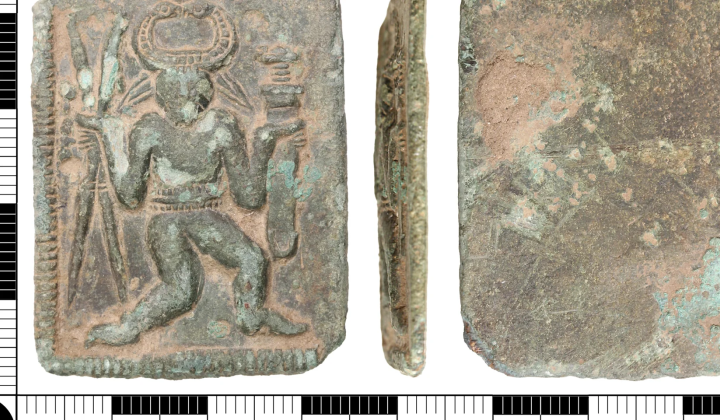
According to НВ — Техно: On June 24 at 9:30 AM, metal detectorist Stephen Newberry uncovered an intact copper alloy stamp, known as a patrix, near the village of Linstead in the UK. This remarkable find challenges the long-held belief that the Sutton Hoo helmets and the Staffordshire Hoard were imported from Scandinavia, suggesting instead that they may have been crafted locally in England.
This is the first stamp of its kind ever discovered in Britain. It depicts an anthropomorphic figure wearing a horned headdress, with the horns ending in bird heads. Beneath the horns are two large triangular ear flaps. In its right hand, the figure holds two spears pointing upward; in its left, it grips a sword in its scabbard, blade pointing down. The stamp functioned as a patrix for the Pressblech technique-a method of embossing used to decorate helmets found in the Sutton Hoo ship burial and the Staffordshire Hoard.
Iconography and Significance of the Find
The helmets from Sutton Hoo and the Staffordshire Hoard feature figures that share distinct similarities with the Linstead stamp: horned headdresses, bird-headed horns, triangular ear flaps, two spears, and a sword. These figures, often called 'weapon dancers,' are commonly found in Denmark, Sweden, and England. Previously, scholars assumed the Sutton Hoo helmets and Staffordshire Hoard were imported from Sweden or Denmark. However, the iconography on this stamp differs from Scandinavian artifacts-the spears point upward, a characteristic associated with English craftsmanship.
Dr. Andrew Richardson, an officer with the Kent Portable Antiquities Scheme, commented on the discovery:
'This small but remarkable find provides important evidence that helmets like the one from Sutton Hoo could have been made in Kent, highlighting the skill of early medieval craftsmen in the county.'
This discovery could significantly reshape the history of metalworking in England and the origins of iconic artifacts like the Sutton Hoo helmet.
For context, in early 2021, an ornithologist in eastern England discovered the largest hoard of Celtic gold coins ever found in Britain. That coin was a mid-1st century stater.
Beyond its archaeological importance, this find sheds light on early medieval English history, emphasizing the role of local production and craftsmanship. It may expand our understanding of cultural and economic connections across different regions of Europe. Studying such artifacts can further illuminate the iconography and stylistic features of the era, while providing new insights into ancient technologies.
This significant discovery adds to the growing body of evidence suggesting that ancient craftsmanship in England was more advanced than previously thought. Similarly, a recent find of an ancient sun temple near Stonehenge further highlights the rich historical landscape of the region, indicating a complex network of cultural influences and local innovations during that era.

Read also