A Unique Stamp Found in England Could Rewrite the History of the Sutton Hoo Helmets

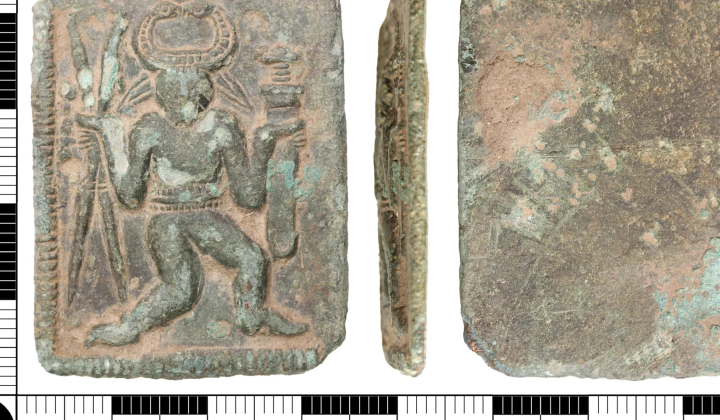
Copper Alloy Die Discovery
According to НВ — Техно: A groundbreaking moment for archaeology and metallurgical history took place in the United Kingdom on June 24, 2023, at 9:30 AM. Metal detectorist Steven Newbery uncovered an intact die made of copper alloy, which may provide evidence that the Sutton Hoo helmets and the Staffordshire Hoard were produced locally in England. Previously, these artifacts were thought to have been imported from Sweden or Denmark. This find has the potential to reshape the narrative around the manufacturing origins of such objects.
Description of the Die and Its Significance
Discovered near the village of Lynsted, the die features an anthropomorphic figure wearing a horned headdress, with the horns ending in bird heads. Beneath the horns, two large triangular ear flaps are visible. The figure holds two upward-pointing spears in its right hand and a sword in its left, sheathed with the blade pointing downward. This die served as a patrix for the pressblech technique, which was used to decorate helmets from the Sutton Hoo ship burial and the Staffordshire Hoard.
The die's iconography shares common elements with the Sutton Hoo and Staffordshire Hoard helmets, including:
- a horned headdress
- triangular ear flaps
- two spears
- a sword
However, it is worth noting that on the helmets, the spears point downward and the swords upward, whereas on the Lynsted die, the spears are directed upward. The figures on the helmets are known as 'dancers with weapons' and may be linked to the worship of Odin.
Dr. Andrew Richardson commented on the discovery, stating: 'This small but remarkable find provides important evidence that helmets like the Sutton Hoo example could have been made in Kent, highlighting the skill of early medieval craftsmen in the county.'
Earlier, in 2021, an ornithologist from eastern England discovered the largest hoard of Celtic gold coins in the UK-a stater from the mid-1st century. The discovery of the copper alloy die could mark a significant step in studying England's metallurgical history and the origins of iconic artifacts. As the first die of its kind found in Britain, it opens up new avenues for research in this field.
The unearthing of this copper alloy die underscores the importance of archaeological work in the UK and its impact on understanding the history of metalworking. It may challenge existing assumptions about helmet production during that era, as well as the skills and technologies of ancient artisans. This find also adds fresh dimensions to the study of cultural connections between different regions of Europe in the early medieval period.
This recent discovery in England adds to the growing list of significant archaeological finds in the region. For instance, just three miles from Stonehenge, researchers uncovered an ancient sun temple, which has sparked discussions about the historical significance of these sites and their connections to early medieval culture.

Read also