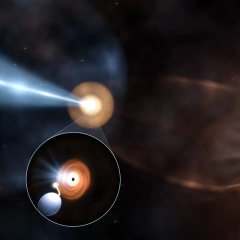
A Second-Generation Planet orbits White Dwarf HS 0209+0832 in Just 4.4 Days

Renewal in the Cosmos
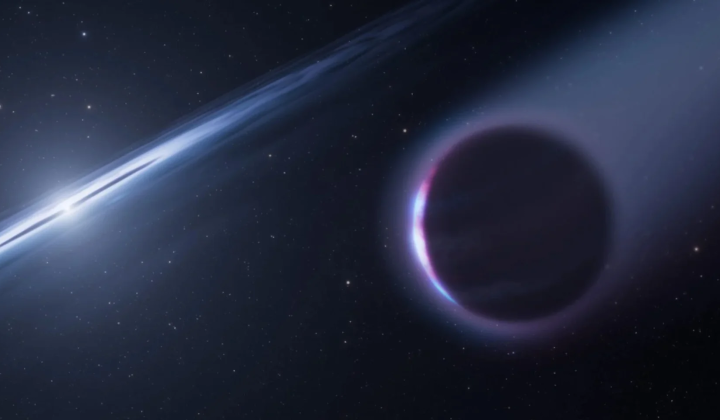
According to НВ — Техно: Researchers at the University of Warwick have uncovered evidence of a possible second-generation planet orbiting the white dwarf HS 0209+0832, located about 270 light-years from Earth. This planet, likely a gas giant comparable in size to Jupiter, completes an orbit around its star every 4.4 days. It is believed to have formed from material expelled by the star after its death. The white dwarf itself is estimated to be around 5 million years old, with a surface temperature near 35,000 °C.
This discovery sheds light on mysterious spectral lines first observed in 1999 by the Hubble Space Telescope. At that time, nearly 100 unidentified spectral features were detected in HS 0209+0832. A recent reexamination revealed the presence of elements such as zinc, copper, and niobium in the white dwarf’s atmosphere. Remarkably, the niobium concentration is over 1,000 times greater than that found in the Sun, indicating the operation of the s-process-a nuclear reaction responsible for creating heavy elements during the late evolutionary stages of stars.
How the Planet Took Shape
This planet orbits at a distance approximately 25 times closer to its star than Earth is to the Sun. It may be tidally locked, keeping one hemisphere perpetually facing the white dwarf. Due to intense stellar radiation, the planet is losing about one billion kilograms of mass every second, with some of this material forming a comet-like tail that streams back toward the white dwarf.
The formation of such second-generation planets could be a common fate for stars similar to our Sun. Should this planet’s existence be confirmed, it might reside within a stable habitable zone for millions of years after its star cools. This raises intriguing questions about planetary formation following a star’s death. As astronomer Jamie Williams noted:
'Over time, as the star cools, the planet could remain within a stable habitable zone for millions of years.' Jamie Williams
This research highlights the importance of studying planetary systems around white dwarfs, revealing the potential for new celestial bodies to emerge after stellar demise, thereby reshaping our understanding of planet formation and evolution.
The finding of a planet orbiting HS 0209+0832 could fundamentally alter current models of how planets form in the universe. It not only supports theories that planets may arise from the remnants of dead stars but also opens up exciting avenues for future astronomical investigations. This work represents a significant step toward understanding the lifecycle of stars and their planetary companions, especially regarding the possibility of life on planets born after their stars have expired. Consequently, this discovery could have profound implications for our grasp of cosmic processes and the potential habitability of worlds beyond our solar system.
This discovery not only highlights the intriguing nature of second-generation planets but also parallels recent findings by NASA's Webb Telescope, which has revealed rare dusty systems around young stars. These insights into planetary formation and evolution could reshape our understanding of how celestial bodies interact and develop in the cosmos.

Read also