Astronomers Identify a Million-Solar-Mass Rogue Black Hole Outside a Galaxy's Core for the First Time

A Rare Discovery: A Black Hole Weighing a Million Suns Wandering Through Space
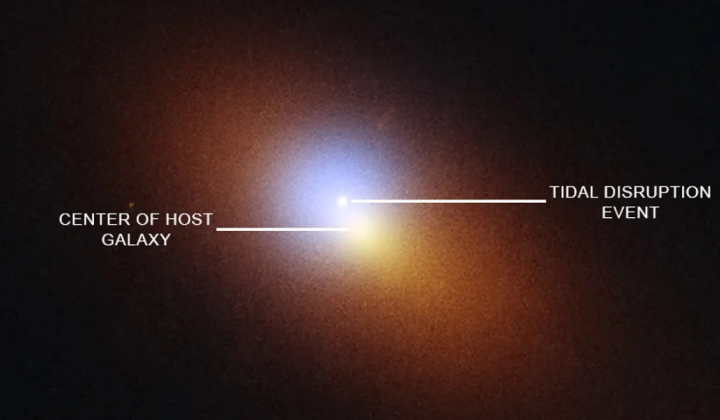
According to НВ — Техно: For the first time ever, astronomers have detected a black hole roaming freely with a mass equivalent to one million times that of our Sun. Unlike typical supermassive black holes found at the centers of galaxies, this extraordinary object lies roughly 567 million light-years away from Earth, far from any galactic core. The discovery was made following the observation of a tidal disruption event (TDE), cataloged as AT2024tvd, where a star was torn apart by the black hole's immense gravity. This event provided the crucial evidence confirming the black hole's existence. The findings were detailed in a recent publication in The Astrophysical Journal Letters.
The event was recorded on October 13 at 22:06. While astronomers have observed around 100 tidal disruption events before, AT2024tvd marks the first time one has been linked to a black hole not anchored to a galaxy’s central supermassive black hole. Positioned about 2,600 light-years from a star that itself weighs 100 million times the mass of the Sun, the black hole's gravitational pull causes plasma to form and emit light across multiple wavelengths as the star approaches it.
Insights from the Study and Its Broader Implications
This black hole was discovered using the Zwicky Transient Facility at the Palomar Observatory. Researchers hypothesize that the black hole originally belonged to a different galaxy that merged with the current host galaxy, resulting in the black hole being displaced from the galactic center. Follow-up observations with the Hubble and Chandra space telescopes provided detailed data confirming the unique nature of this object.
This breakthrough expands our understanding of black hole behavior and evolution beyond the conventional model centered on galactic cores. The presence of such a wandering black hole could reshape future research on galactic dynamics and the formation of cosmic structures. Moreover, the data collected during this event may offer new perspectives on the interactions between black holes, stars, and other celestial bodies, potentially inspiring revised theoretical frameworks in astrophysics.
This remarkable discovery opens new avenues for understanding black holes in various contexts. For instance, recent research has uncovered a universal pattern in jet formation that applies to black holes of all sizes, further enriching our grasp of their behavior and interactions in the universe.

Read also