Human-Eye-Inspired Chip Developed by Australian Researchers

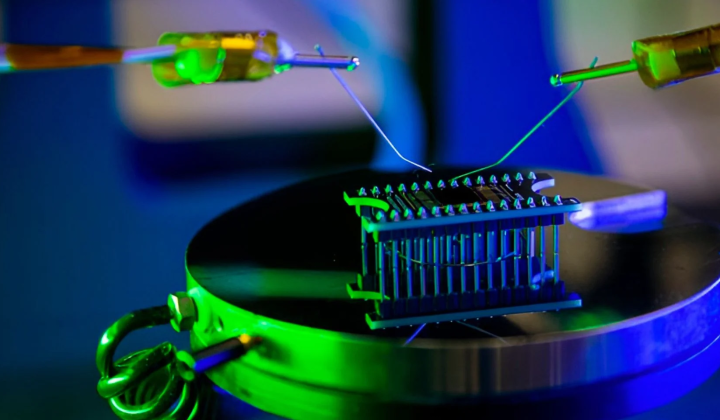
A Neuromorphic Chip for Image Processing
According to НВ — Техно: A team of engineers from RMIT University, in collaboration with researchers at Deakin University and the University of Melbourne, unveiled a new neuromorphic image-processing chip on June 16 at 3:00 PM. Designed to mimic the human eye and brain, this chip performs computations directly at the point where light is captured. It is built from doped indium oxide and features a light-sensitive layer thousands of times thinner than a human hair.
Initial tests of the chip were conducted using ultraviolet light, and work is now underway to extend its capabilities to visible and infrared spectrums. Lead researcher Professor Sumeet Walia explained that
“the goal was to eliminate the delays and energy costs associated with transferring data between separate systems.”
He also emphasized that
“the invention enables real-time decision-making, as it avoids processing large amounts of irrelevant data and wastes no time sending information to separate processors.”
Co-author and RMIT PhD candidate Aishani Mazumder noted that
“the system is inspired by how the human brain processes information.”
She added that
“neuromorphic vision systems use similar data-processing principles, requiring far less energy for complex visual tasks compared to current technologies.”
Potential Applications of the New Technology
This breakthrough technology has several promising applications, including:
- self-driving cars
- autonomous robots
- monitoring systems for hazardous environments
- object recognition in transportation
- detection systems in remote or high-risk areas
- advanced imaging techniques for forensics and industrial inspections
The development of this neuromorphic chip represents a major leap forward in image-processing technology. With its ability to operate in real time while consuming minimal energy, it has the potential to transform automation and smart technology. Integrating such solutions across fields like transportation and security could significantly boost the efficiency and safety of modern systems.
As researchers continue to explore the intersection of biology and technology, recent advancements have shown that human neurons on a chip can learn to play games. This innovative development highlights the potential of biological systems to enhance computational processes, much like the neuromorphic chip designed to replicate the human eye's efficiency in image processing.

Read also