Variable Water Clouds Detected Outside Our Solar System on Brown Dwarf WISE 0855 by James Webb Telescope

Jupiter-Like Weather Patterns Observed
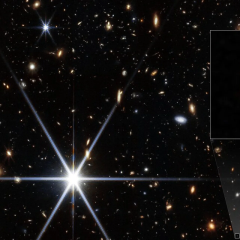
According to НВ — Техно: For the first time beyond our Solar System, fluctuating water clouds have been detected. Astronomers from the University of Arizona observed changing water cloud formations on the brown dwarf WISE 0855, located 7.5 light-years from Earth. These findings come from 11 hours of observations at 15-minute intervals using the James Webb Space Telescope. The study revealed variations in the thickness of water clouds high in the atmosphere, alongside deeper atmospheric convection cycles.
Insights into WISE 0855
WISE 0855 has an approximate temperature of −8°C and a mass estimated between 3 and 10 times that of Jupiter. Brown dwarfs capable of deuterium fusion typically range from 13 to 80 Jupiter masses. Notably, WISE 0855 is the smallest isolated star-like object not orbiting a star and is among the closest stellar objects to Earth, surpassed only by Alpha Centauri, Barnard's Star, and Luhman 16. The data suggests a rotation period of about 9.33 hours, though this measurement remains tentative.
Research into the water clouds on WISE 0855 has been ongoing since 2014. Brittany Miles, a member of the research team, highlighted:
“This is the first time we’ve been able to confirm that water clouds on a neighboring world change in thickness.”
This breakthrough opens new avenues for studying atmospheric phenomena on exoplanets. Co-researcher Mark Marley compared the observations to
“looking through a screen door that filters some light; we learn about the world on both sides but must also understand the screen itself.”
The findings have been accepted for publication in The Astrophysical Journal, underscoring their significance in advancing our knowledge of atmospheric processes beyond the Solar System.
Detecting dynamic water clouds on WISE 0855 marks a major advancement in exoplanetary and brown dwarf atmospheric research. This study provides crucial data for understanding climate conditions on distant worlds and enhances observational techniques. The results also highlight the James Webb Telescope's powerful role in probing far-off celestial bodies, paving the way for future astronomical discoveries.
These groundbreaking observations of water clouds on WISE 0855 are not isolated; similar atmospheric phenomena have been detected on other brown dwarfs. For instance, a recent study on the brown dwarf SIMP 0136 revealed repeated patterns linked to cloud formations and temperature fluctuations. Such findings deepen our understanding of the complex atmospheres beyond our Solar System.

Read also