Bumblebees Spontaneously Use a Ball as a Tool for the First Time

Exploring Bumblebee Cognitive Skills
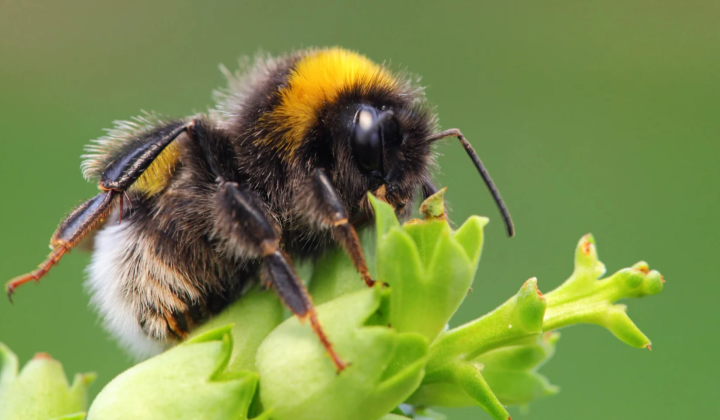
According to НВ — Техно: In a groundbreaking experiment, researchers from the University of Oulu, the University of Helsinki, and the University of Turku observed bumblebees using a ball as a tool to access food without any prior training. The task required the insects to reach a blue artificial flower containing a reward, suspended from the ceiling of a transparent structure. The bumblebees began rolling the ball beneath the flower and climbing on top of it, despite having no previous experience using objects to solve problems. This behavior highlights their advanced cognitive abilities.
Lead author Akshay Bhambore noted that this was an entirely new challenge for the bumblebees. He added that the actions of successful individuals appeared purposeful, with their movements becoming more organized over time. The bumblebees seemed to understand two separate concepts: that the blue flower held a reward and that the ball could be moved. The team conducted additional control experiments, one of which completely concealed the target flower from the bumblebees. Remarkably, the insects still moved the ball to the correct location, even when the flower was hidden.
“This is the first time an insect has demonstrated such spontaneous problem-solving,” said senior author Olli Loukola.
Loukola also emphasized that the bumblebees were not moving the balls randomly or merely reacting to visual cues. However, the scientists do not claim that bumblebees think like humans. Loukola added that even a tiny brain can find flexible solutions to new challenges.
Study Conclusions
Described as an insect version of the classic “box and banana” problem, the study illustrates a shift from chaotic movement to rapid and efficient task resolution, serving as an example of complex cognitive abilities in bumblebees. These findings build on previous evidence that bees can:
- cooperate
- adapt to new conditions
- learn complex actions
However, the study does not imply that bumblebees possess human consciousness or engage in abstract reasoning. Instead, it broadens biologists’ understanding of how complex forms of thinking might have emerged through evolution.
This research opens new horizons in understanding the cognitive abilities of insects, particularly bumblebees. It demonstrates that even animals with simple nervous systems can exhibit complex behaviors and problem-solving skills, highlighting the evolutionary aspects of intelligence in nature. The results may serve as a foundation for further studies in evolutionary biology and cognitive science, potentially inspiring new discoveries in the study of other insect species.

Read also