Among Two Ukrainian Cases, ECtHR Identified a Violation in Just One

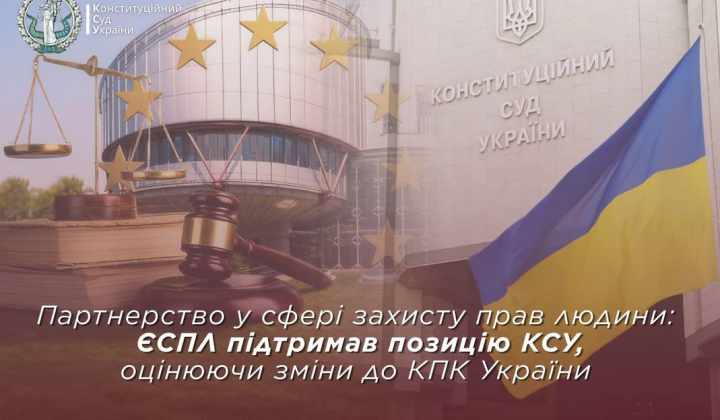
According to Конституційний суд: The European Court of Human Rights (ECtHR) frequently handles cases from Ukraine, often centering on pretrial detention and judicial independence. Recent decisions have drawn directly on landmark rulings by Ukraine’s Constitutional Court (CCU).
ECtHR Rulings on Two Ukrainian Applications
On July 23, 2026, the ECtHR issued judgments in the paired cases of Kolesnyk and Smelnytskyi v. Ukraine and Derevyanko and Tarasova v. Ukraine. In the first case, the Court found no violation of the European Convention on Human Rights. In the second, however, it concluded that a violation had occurred. Both decisions relied on a CCU ruling from June 19, 2024.
The CCU’s decision (No. 7‑r(II)/2024) – cited by the ECtHR – holds that pretrial detention is not the only possible preventive measure and that bail is permissible under Article 176, part 6, of Ukraine’s Criminal Procedure Code. The reporting judges in that CCU case were Viktor Horodovenko and Volodymyr Moysyk.
Consequences for Ukraine’s Judicial System
Additionally, in the July 21, 2021 judgment of Gumenyuk and Others v. Ukraine, the ECtHR endorsed the CCU’s conclusions from its February 18, 2020 ruling (No. 2‑r/2020) regarding the breach of the principle of judicial tenure security. There, the Court pointed out that the applicants had been forced to compete in order to keep their right to serve as judges.
Oleksandr Petryshyn, acting President of the CCU, remarked: “The Constitutional Court of Ukraine is not merely a recipient of the standards of the Convention for the Protection of Human Rights and Fundamental Freedoms, but also an active subject shaping European legal discourse.”
Thus, the ECtHR and CCU rulings continue to drive the evolution of justice in Ukraine, especially under martial law. These judgments highlight the imperative of upholding human rights even in challenging judicial contexts. The recognition of the CCU as an active contributor to European legal discourse underscores its role in crafting legal standards essential for the administration of justice in Ukraine – a role made even more critical amid the country’s current difficulties, including the state of war.
The evolving landscape of Ukraine’s judicial system is further underscored by the recent ruling from the Constitutional Court, which eliminated the mandatory detention of military personnel. This decision not only aligns with the principles established by the European Court of Human Rights but also reflects a significant shift in legal practices. To understand the implications of this ruling, you can read more about the overturning of compulsory arrest for military personnel.

Read also