Physicians Uncover a Novel Critical Phase of Matter


Exploring an Unprecedented State of Matter
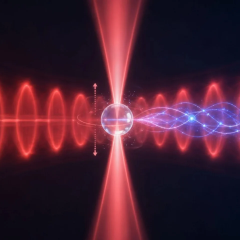
According to НВ — Техно: A study featured in Physical Review Letters has revealed the emergence of a new critical phase of matter when quantum particles are driven out of equilibrium. Led by Hans-Christoph Nägerl, the research team employed ultracold cesium atoms confined to a single dimension. By adjusting the atomic interactions from strong repulsion to strong attraction, they successfully transitioned these atoms into a highly excited fractal configuration.
This resulting state exhibited unusual properties, including distinct mathematical correlations and unique pulsations. This novel phase transcends the Tomonaga-Luttinger liquid theory, indicating that even in an excited state, a hidden, well-defined order exists, as noted by Hans-Christoph Nägerl.
Yi Zeng remarked, 'this approach allows us to investigate quantum matter beyond classical frameworks.'
Discovery of Quasiparticles: Superfermions
The research also led to the identification of new quasiparticles, which may be termed superfermions. This advancement opens fresh avenues for further exploration of quantum systems and their characteristics. The ultracold cesium atoms, locked into a hidden ordered state after alternating repulsive and attractive interactions, underscore the significance of these findings in modern physics.
These results have the potential to dramatically expand our understanding of quantum systems and their behavior. The detection of new quasiparticles like superfermions could drive progress in quantum computing and materials science technologies. Additionally, these discoveries may influence future studies in condensed matter physics, offering new opportunities to investigate complex quantum phenomena.
These groundbreaking findings not only enhance our understanding of quantum systems but also resonate with recent developments in theoretical physics. For instance, researchers have demonstrated that quantum mechanics can be described without imaginary numbers, suggesting a deeper exploration of the foundational principles governing quantum phenomena. Such insights could further illuminate the complexities of new phases of matter and their implications for future technologies.

Read also