Meta’s AI Achieves 78% Accuracy in Decoding Thoughts from Brain Activity

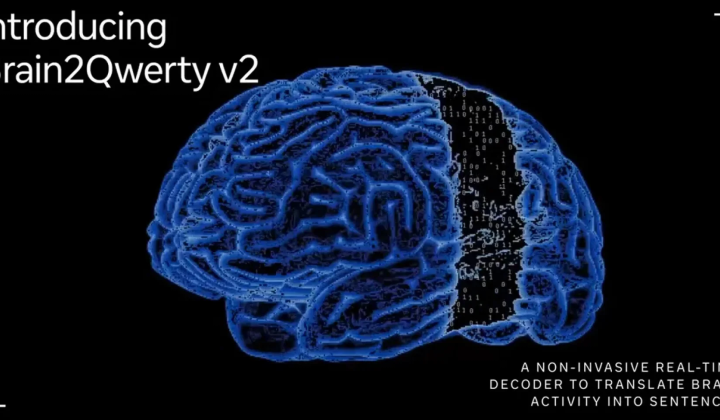
Meta’s Brain2Qwerty v2 System
According to НВ — Техно: Meta’s Brain2Qwerty v2 system shows strong potential for converting brain signals into coherent sentences without requiring invasive surgery. In its most successful trial, the system reached a word recognition accuracy of 78%. The model was trained at the Basque Center on Cognition, Brain and Language in San Sebastián, Spain, involving nine healthy volunteers aged 25 to 56. These participants typed over 2,500 sentences across ten sessions, while their brain activity was recorded using magnetoencephalography (MEG).
Magnetoencephalography detects the tiny electrical fields generated by neural firing, and this technology significantly improved recognition outcomes. For Brain2Qwerty v2, more than half of the decoded sentences contained no more than one word error. By comparison, the earlier version, Brain2Qwerty v1, achieved at best only 48% accuracy. The Brain2Qwerty v2 system employs pattern recognition technology similar to that used in chatbots like ChatGPT and Meta’s own Llama.
How the Decoding Process Works
The process of extracting information from brain activity involves three stages:
- converting brain waves into tokens;
- arranging characters into words;
- transforming sets of characters and words into sentences using a large language model (LLM).
The findings from this study mark the first successful application of an LLM to turn noisy brain signals into structured sentences. Meta’s engineers are confident that this research has the potential to meaningfully improve the lives of millions of people who suffer from brain injuries that impair their ability to communicate.
The researchers also note that if extended training on non-invasive MEG data can eliminate the need for neurosurgery in such cases, it could represent a transformative shift in patient care. Meta hopes that the results of this openly conducted work will advance neuroscience, leading to faster detection, diagnosis, and treatment of neurological disorders. The code for both Brain2Qwerty v2 and its predecessor is already available online, opening new avenues for research in this field.
This breakthrough in brain activity decoding technology could fundamentally change approaches to treating patients with neurological disorders and provide new communication possibilities for people who previously lacked such ability.
Open access to the Brain2Qwerty v2 system’s code is expected to encourage further neuroscience research and support the development of new treatment methods based on intrinsic brain activity.
Interestingly, recent studies have shown that even when under general anesthesia, the brain remains capable of recognizing speech and anticipating words. This phenomenon highlights the intricate relationship between brain activity and communication, which complements the advancements made by Meta's Brain2Qwerty v2 system. To learn more about how the brain processes language in such unique conditions, you can read further here.

Read also