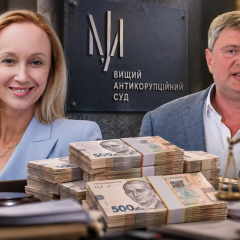
Court Upholds $2.8 Million Bail for Midas Case Defendant


Ihor Myroniuk's Bail in the Midas Case
According to Главком: The Appeals Chamber of the High Anti-Corruption Court has confirmed the 112 million hryvnia (approximately $2.8 million) bail for Ihor Myroniuk in the Midas case. A prosecutor had appealed the decision, arguing that reducing the bail from 126 million to 112 million hryvnia was unjustified. The court's ruling means the lowered amount remains in effect.
Details of the Midas Case
The Midas case, in which Ihor Myroniuk is a key figure, involves corruption schemes in Ukraine's energy sector. On November 10, 2025, the National Anti-Corruption Bureau of Ukraine (NABU) formally charged seven individuals in this case. Besides Myroniuk, the suspects include:
- Businessman Tymur Mindich, co-founder of the Kvartal-95 studio;
- Dmytro Basov, executive director for security at Energoatom;
- Oleksandr Tsukerman;
- Ihor Fursenko;
- Lesya Ustymenko;
- Liudmyla Zorina.
Herman Halushchenko, also suspected of embezzling funds from Energoatom, appears in recorded conversations under the code names Professor and Sigismund.
On March 5, 2025, the High Anti-Corruption Court extended Ihor Myroniuk's pre-trial detention by two months while simultaneously reducing his bail. That same day, the court also extended Herman Halushchenko's detention, underscoring the severity of the charges against him.
Corruption cases in the energy sector draw significant public attention due to their potential far-reaching impact on the national economy and trust in state institutions. The high bail amounts and the number of suspects highlight the scale of these corruption networks, emphasizing the need for continued investigations and reforms in this area.
The ongoing developments in the Midas case reveal a complex web of corruption within Ukraine's energy sector. Recent allegations involving significant financial misconduct highlight the broader implications of these charges, further emphasizing the critical need for transparency and accountability in governmental institutions.

Read also