Sturgeon Populations Surge in the Danube and Dnipro Rivers, Offering Hope for Endangered Species

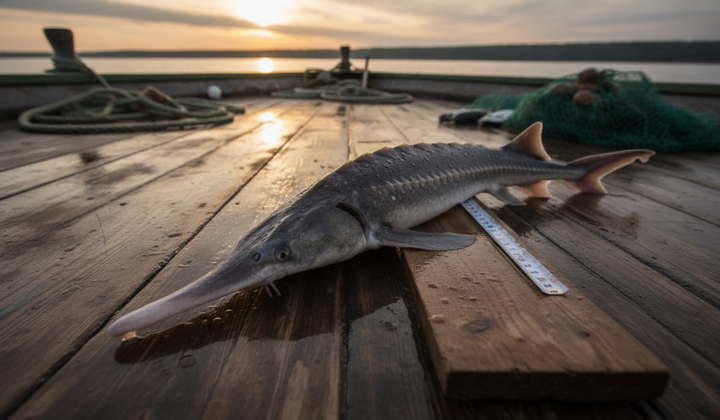
War-Related Fishing Bans Drive Sturgeon Recovery in the Danube
According to Главком: The suspension of commercial fishing during wartime has led to a notable increase in sturgeon numbers in the Danube River. After 2014, fishing in the area was partially restricted, and by 2022, it became entirely impossible due to military occupation. As a result, scientists have documented a rise in sturgeon counts in the Danube and the reappearance of adult specimens in the Dnipro River.
“The Danube hosts four typical sturgeon species: three migratory and one resident. We have been monitoring them for over five years and can confirm that both their numbers and the frequency of sightings are steadily increasing. The wartime fishing restrictions have certainly played a key role,”
– Dr. Viktor Demchenko, Deputy Director of the Institute of Marine Biology, National Academy of Sciences of Ukraine.
Ukraine is home to several rare sturgeon species listed in the Red Book: the stellate sturgeon, sterlet, beluga, and Russian sturgeon. After 2014, limitations on industrial fishing allowed these populations to begin recovering. All sturgeon fishing is banned because these species are protected under the Red Book. Notably, a single mature female carrying eggs-black caviar-can be worth around one thousand dollars on the black market.
“Some fishermen release sturgeon back into the water, but unfortunately, others do not. The temptation is huge: one adult fish, especially a female with roe-which is black caviar-can bring in about a thousand dollars,”
– Viktor Demchenko.
In the Danube, researchers previously recorded 10 to 15 sturgeon individuals per year; that number has now climbed to 40 to 50. Since 2023, five adult sturgeon weighing between 10 and 15 kilograms have also been found in the Dnipro River. Two main theories explain their presence there:
- Fish escaped from a sturgeon hatchery in the village of Dniprove near Kherson, which was flooded after the destruction of the Kakhovka Hydroelectric Plant;
- Wild sturgeon that feed in the Black Sea may be seeking new spawning grounds in the Dnipro.
For successful reproduction, sturgeon require cold water, a rocky riverbed, and a current speed of 1 to 1.5 meters per second. Such conditions exist near Khortytsia Island. Previously, the Kakhovka Dam blocked access to these spawning areas. Ukraine has officially declared two sturgeon species-the Atlantic sturgeon and the ship sturgeon-as extinct in the wild. The beluga, stellate sturgeon, sterlet, and Russian sturgeon are currently threatened with extinction.
This trend signals positive changes in the ecosystem of Ukraine’s rivers, likely driven by fishing restrictions, which in turn could help revive endangered species. Restoring sturgeon populations is critical for biodiversity and ecological stability, but challenges such as poaching and weak enforcement remain. Scientists continue to monitor the situation to assess how these shifts will affect the long-term survival of sturgeon and their habitats.
The positive developments in sturgeon populations are not isolated, as similar trends have been observed in other aquatic ecosystems affected by conflict. For instance, recent reports indicate that the ecological recovery in the Black Sea has also been significantly influenced by wartime conditions. This unexpected resurgence highlights the intricate relationship between human activity and environmental health. To learn more about how war has inadvertently fostered ecological improvements, read about the surprising recovery in the Black Sea.

Read also