3,000-Year-Old Feudal Estate with Thousands of Tombs Unearthed in China

The Changchun Feudal Estate Discovery
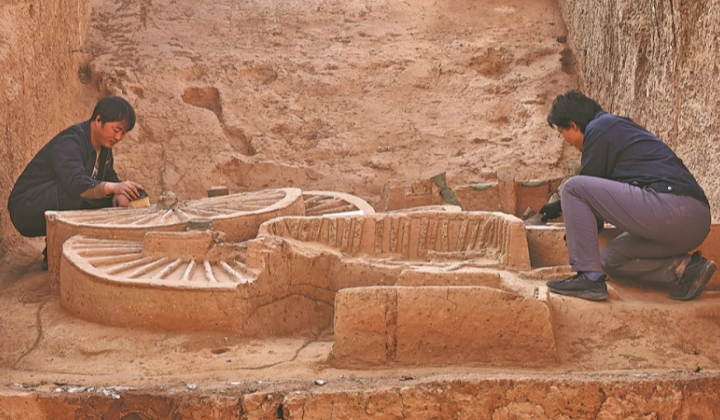
According to НВ — Техно: In Shaanxi Province, China, archaeologists have uncovered a 3,000-year-old feudal estate known as Changchun, dating back to the Western Zhou period. The excavation, which began in 2022 as a rescue operation following the discovery of looted graves, has revealed a vast cemetery containing over 3,150 tombs and a settlement spanning roughly 2 million square meters. This site offers new insights into the hierarchical structure and economic organization of the era.
Changchun is situated in Fuping County, within the eastern Guanzhong region. The entire site covers approximately 2.2 million square meters, with the cemetery occupying about 200,000 square meters. Within the cemetery, more than 3,150 tombs and chariot pits have been identified. Twelve of these tombs feature passageways, and all are oriented toward the northeast. Notable finds include a gold beast-mask ornament, a dragon-motif jade tablet, and artifacts made from fossilized coral.
Social Hierarchy and Economic Framework
The settlement, located south of the cemetery, covers around 2 million square meters and is bounded by the Shichuan River and two man-made moats. In a roughly 50,000-square-meter section, archaeologists uncovered 30 pottery kilns, pointing to a highly developed ceramics industry. A pit near the workshop contained the remains of four individuals; DNA analysis revealed that two of them were a mother and her son.
The Changchun discovery is crucial for understanding the social and economic systems of the Western Zhou period, which ruled from around the 11th century BC until 771 BC. As archaeologist Li Yanfeng noted,
“nothing of this size and organization has ever been found in the eastern part of Guanzhong.”
Researcher Wang Wei added, “this type of water-related multi-network layout is the first ever identified at a Western Zhou site.” Artifacts such as the gold beast-mask ornament, the dragon-patterned jade tablet, and items made from fossilized coral reflect the high level of craftsmanship and cultural sophistication among the inhabitants. Additionally, production debris from bronze casting, pottery making, and horn tool manufacturing indicates a thriving economic system.
The scale of the pottery kilns at Changchun is comparable to the ceramic workshop zones in Fenghao, a major Western Zhou center near modern-day Xi’an. This find opens new avenues for studying the cultural heritage and social organization of ancient China.
Beyond enriching knowledge about Western Zhou culture and social structures, the Changchun excavation provides fresh opportunities for archaeological research in the region. The artifacts and architectural features point to advanced arts and crafts, as well as complex economic and social networks. This discovery marks a significant milestone in the study of ancient Chinese history and its cultural legacy.

Read also