500-Million-Year-Old Fossil Reveals Earliest Evidence of Spider-Like Fangs

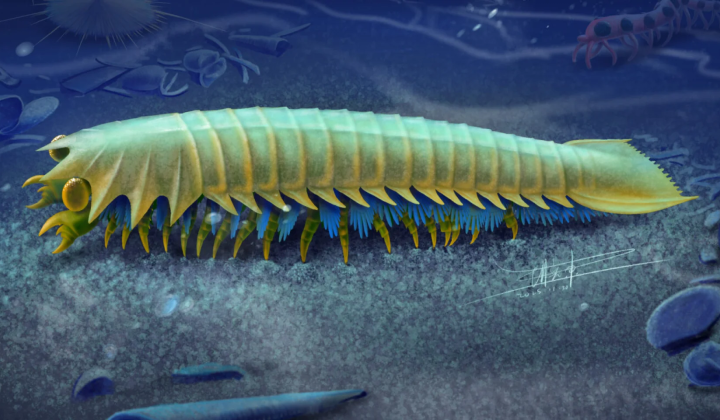
Discovery of Urokodia aequalis
According to НВ — Техно: Scientists have uncovered the oldest known evidence of fang-like structures in a fossilized creature called Urokodia aequalis, which lived more than 500 million years ago during the early Cambrian period. The specimen was found in what is now China. Measuring just 2 to 3 centimeters in length, this ancient animal had an elongated, segmented body, numerous tiny legs, a shrimp-like tail, and a protected head featuring stalked eyes. Behind those eyes sat a pair of small appendages that researchers have identified as an early form of chelicerae-the mouthparts found in modern spiders, scorpions, mites, horseshoe crabs, and other chelicerates.
Although fossils of Urokodia have been known for decades, the faint traces of these fang-like structures were only revealed through X-ray tomography, which exposed remarkably preserved soft tissues. This discovery is significant because the previous oldest example of chelicerae belonged to the arthropod Megachelicerax cousteaui, which lived 14 million years after Urokodia.
Significance of the Find
Paleobiologist Yu Liu from Yunnan University commented:
'We used X-ray tomography on these fossils to uncover their soft anatomy, buried in rock for hundreds of millions of years, when we suddenly noticed claw-like limbs at the front of the animal.' - Yu Liu
Yu Liu added: 'We immediately realized this was an extremely interesting fossil and truly a distant ancestor of modern chelicerates, such as scorpions and spiders.' The research findings were published in the journal Nature, highlighting the importance of this discovery for understanding the evolution of chelicerate organisms. An artistic reconstruction of Urokodia aequalis was illustrated in a photo prepared by researcher Xiaodong Wang. This find opens new horizons in the study of early life forms on Earth.
The discovery of Urokodia aequalis adds crucial data to our understanding of evolutionary links between early arthropods and modern chelicerates. It also demonstrates how advanced techniques like X-ray tomography can help study ancient fossils, revealing their anatomy and unlocking new possibilities in paleontology. This finding has the potential to reshape scientific views on arthropod evolution and adaptation over millions of years.
The discovery of ancient creatures continues to shed light on the evolutionary history of various species. For instance, recent findings in Spain revealed a new species of bear-dog, highlighting the diversity of prehistoric fauna. This exciting development complements the understanding of evolutionary adaptations seen in other ancient organisms, such as the newly discovered bear-dog fossils, which also provide insights into the adaptive traits of carnivorous mammals.

Read also