Why a Salted Cucumber Glows Bright Orange Under Electricity, Explained by an American Physicist

The Cucumber Experiment
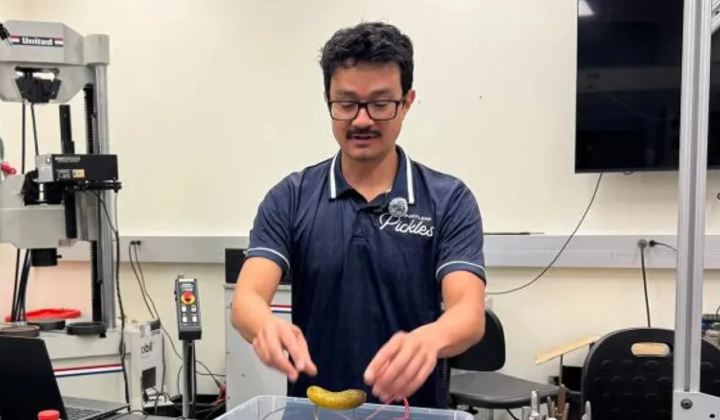
According to НВ — Техно: Josh Mendez, a physicist from Portland State University, uncovered the science behind the orange glow emitted by a salted cucumber when subjected to an electric current. This phenomenon occurs due to hydrogen gas and spark discharges generated through the processes of electrolysis and the cucumber's electrical resistance. To trigger the effect, electrodes are inserted into both ends of the cucumber. During the demonstration, the cucumber hisses, emits smoke, and glows orange at only one end.
The salt in the cucumber enhances its conductivity, enabling current flow and initiating the electrolysis of water inside, which breaks down into hydrogen and oxygen. Hydrogen accumulates near the negative electrode, while sparks form because of the cucumber’s resistance, heating it up and creating pockets of gas. These hydrogen-oxygen mixtures ignite from the sparks, causing the cucumber to glow intensely. According to Mendez:
“Hydrogen plays a key role here, but it’s the spark-not heat-that ignites it.”
The Physics Behind the Phenomenon
The bright orange light comes from excited sodium atoms released during the sparks. If cucumbers were pickled in potassium chloride instead, the glow would appear differently. Earlier studies in 2015 by Michael Follmer and Klaus-Peter Mellmann confirmed hydrogen’s involvement, while a Hamburg-based research team linked the effect to spark discharges. Similar electrical breakdowns occur not only in cucumbers but also in grapes heated in microwaves, where plasma forms; in cucumbers, it manifests as an electric arc.
Mendez further explains: “When the water returns to the electrode, a small electric arc jumps between the liquid and the metal, similar to the tiny shock you feel touching a doorknob after walking on carpet.” It’s important to note that attempting this experiment at home can be hazardous due to risks like short circuits and hydrogen buildup.
This demonstration vividly illustrates fundamental principles of electrolysis and electric discharges. Exploring such effects deepens our understanding of not only electrical interactions but also complex phenomena involving plasma and gases. However, safety precautions are crucial since even seemingly simple experiments can have unexpected dangers.

Read also