James Webb Identifies Dwarf Galaxy as Source of Most Distant Fast Radio Burst FRB 20240304B

A Glimpse from the Early Universe
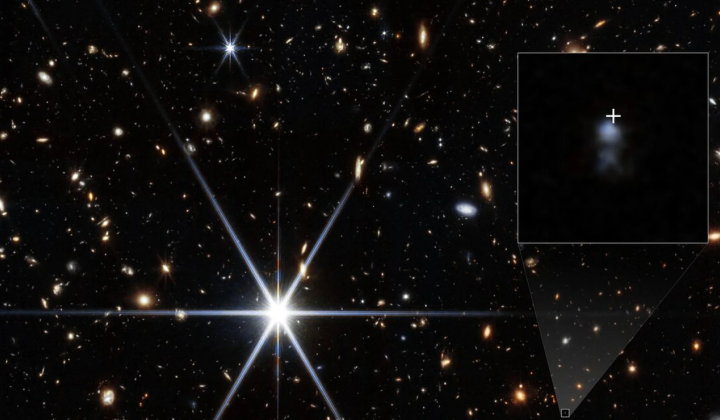
According to НВ — Техно: Using the James Webb Space Telescope, astronomers have pinpointed a dwarf galaxy as the origin of the most distant fast radio burst (FRB 20240304B) ever recorded. This intense radio signal was detected on March 4, 2024, by the MeerKAT radio telescope. The host galaxy exhibits a redshift of 2.148, placing it roughly 3 billion years after the Big Bang, during a peak era of star formation in the cosmos. Remarkably, this galaxy is about a thousand times smaller than previously expected for such a source.
Insights from the Research
The investigation utilized the NIRCam instrument aboard the James Webb Telescope. While fast radio bursts typically originate from massive galaxies with vigorous star formation, this case challenges that assumption by involving a much smaller dwarf galaxy. Astronomer Manisha Caleb noted that, despite active star creation within this galaxy, they had anticipated a large, well-developed galaxy with a substantial stellar population.
“Although star formation was ongoing, we expected the source to be a large, well-formed galaxy rich in stars.” – Manisha Caleb
Most of the stars in this dwarf galaxy likely formed within a span of just 30 million years. The radio signal also revealed a galaxy cluster approximately 3.5 billion light-years away, along with the Virgo Cluster at a distance of 54 million light-years. Fast radio bursts have been known since 2007, and MeerKAT’s projections suggest that several bursts with redshifts above 1.0 will be discovered annually.
“Our findings strongly suggest that this FRB was unlikely caused by a merger event.” – Manisha Caleb
The study, published in the journal Science, highlights the James Webb Telescope’s groundbreaking capabilities in probing the distant universe. As astrophysicist J. Xavier Prochaska explained, “A fast radio burst acts like a cosmic flashlight, illuminating everything along its path,” emphasizing the significance of such discoveries for advancing astronomy.
Identifying a dwarf galaxy as the source of this record-breaking radio burst broadens our understanding of galaxy evolution in the early universe. This breakthrough underscores the critical role of the James Webb Telescope in exploring celestial objects previously beyond reach. With these new data, astronomers can delve deeper into the processes behind star and galaxy formation as well as the enigmatic nature of fast radio bursts. These insights have the potential to reshape foundational concepts in astrophysics.
In addition to the remarkable discovery of the dwarf galaxy linked to FRB 20240304B, the universe continues to reveal its secrets. For instance, researchers have recently confirmed the existence of a powerful radio galaxy that dates back nearly 12.5 billion years, highlighting the diverse origins and characteristics of cosmic phenomena. This emphasizes the evolving understanding of galaxy formation and star activity in the early universe.

Read also