For the First Time, a Chinese Telescope Has Captured a Black Hole Destroying a White Dwarf

Pinpointing an X-Ray Source
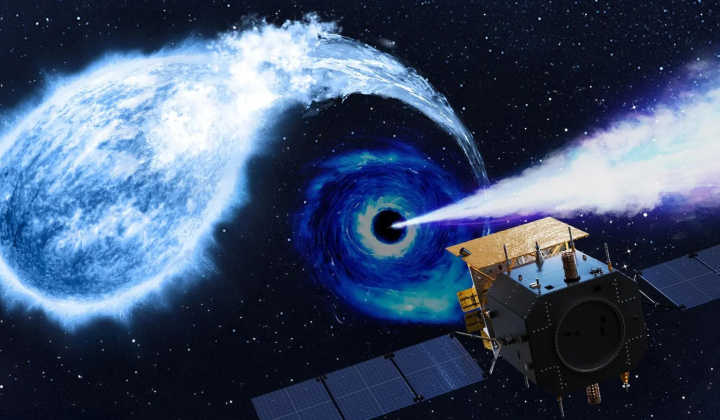
According to НВ — Техно: China's Einstein Probe (EP) space telescope has identified an X-ray source designated EP250702a. Researchers believe this marks the first direct evidence of a white dwarf being torn apart by an intermediate-mass black hole. The findings were published in the journal Science Bulletin. For context, intermediate-mass black holes are a rare and poorly understood class, making this observation especially significant for astrophysics.
The telescope employs a wide-field X-ray instrument based on lobster-eye optics, a novel technology that allows it to monitor large swaths of the sky. Notably, NASA's Fermi gamma-ray telescope also detected bursts in the same region, underscoring the event's importance. Roughly 24 hours before the main event, the telescope recorded a steady X-ray signal.
Key Traits of the EP250702a Flare
The EP250702a flare ranks among the brightest transient phenomena ever observed in the universe, with a peak luminosity of 3×1049 erg s-1. The event occurred on the outskirts of a distant galaxy-not in its core-which adds another crucial detail for scientists. Over the following 20 days, the object's brightness dropped by a factor of more than 100,000, while its emissions shifted from a hard X-ray spectrum to a softer one.
Distinguishing features of the flare include:
- a prolonged precursor signal;
- record-breaking brightness;
- an unusually rapid evolution;
- a location at the galaxy's periphery.
The scientists concluded that this phenomenon results from the tidal disruption of a white dwarf by an intermediate-mass black hole. The DOI for the published findings is 10.1016/j.scib.2025.12.050.
This research, conducted with the Einstein Probe, opens new frontiers in understanding the complex interactions between stars and black holes, which could have major implications for astrophysics.
The discovery has the potential to reshape scientific views on stellar evolution and black hole formation, particularly concerning intermediate-mass objects. Detecting such events is a crucial step in space research, as they help confirm theories about star–black hole interactions and provide fresh data for future astronomical observations.
In addition to this groundbreaking discovery, recent observations have unveiled a mysterious cosmic phenomenon that defies expectations by lacking gamma-ray emissions. This finding highlights the diverse and complex nature of cosmic events, further enriching our understanding of the universe and the forces at play within it.

Read also